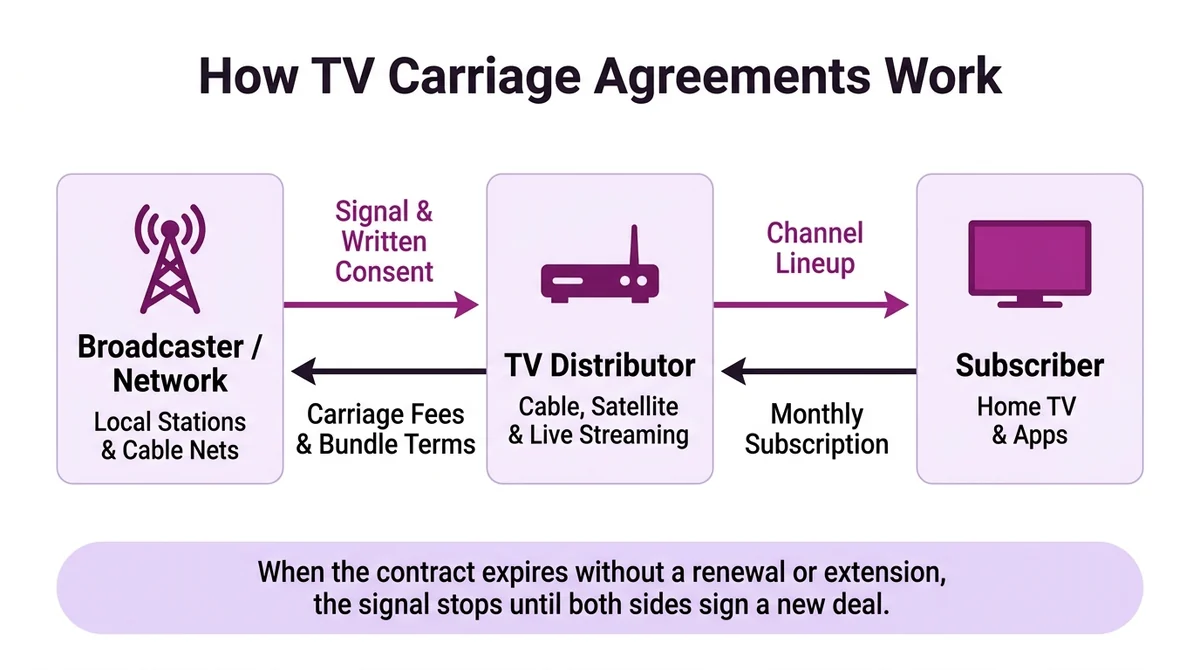
A carriage dispute is a contract disagreement between a television broadcaster or cable network and a TV distributor over the right to retransmit a channel’s signal. When a contract expires without a renewal or short extension, the distributor loses permission to carry that programming, and affected channels go dark across cable, satellite, or live-TV streaming lineups.
Viewers often mistake a sudden channel blackout for a broken set-top box, an internet glitch, or a permanent network shutdown. In reality, a blackout is usually the visible pause point of a commercial contract negotiation governed by federal retransmission rules and private distribution deals.
What does carriage dispute mean, and what is a carriage fight?
A carriage dispute means a disagreement over the legal right to carry, or retransmit, a broadcaster’s or network’s signal across a pay-TV service. Carriage disputes began between broadcasters and cable operators and now include direct broadcast satellite services and other multichannel video programming distributors (MVPDs), as summarized in Wikipedia’s carriage dispute overview.
A carriage fight refers to the same negotiation standoff, especially when talks spill into public view. Most carriage disputes settle quietly before any channel disappears, without public controversy or viewer notice. Other disputes have involved threatened or active programming blackouts alongside strident public relations campaigns, turning a routine contract renewal into a high-profile carriage fight.
Three practical issues sit at the center of almost every dispute:
- Financial compensation: What the TV distributor pays the local station group or cable network owner for permission to carry its signal.
- Channel inclusion: Which networks in a media company’s portfolio the distributor is permitted or required to carry.
- Packaging and tiers: How the distributor offers those channels to subscribers, such as placing a sports network on a basic tier versus an optional add-on tier.
Under federal rules in 47 CFR 76.64, an MVPD is an entity such as a cable operator or direct broadcast satellite service that makes multiple channels of video programming available for purchase by subscribers. Live-TV streaming platforms negotiate comparable commercial carriage deals with station groups and cable programmers, so subscribers see the same channel-removal notices across traditional boxes and streaming apps.
Why do carriage disputes happen?
Carriage disputes happen because television distribution depends on time-limited written contracts, and broadcasters and distributors have opposing financial incentives whenever those agreements come up for renewal. Under federal law, a distributor cannot simply keep retransmitting a commercial broadcast station’s signal after permission expires, and networks use deadline pressure to seek higher fees or broader channel carriage.
Retransmission consent and the three-year election cycle
The modern U.S. framework grew out of decades of friction over whether cable operators could redistribute free broadcast signals without paying local stations. From February 15, 1966, to December 18, 1968, the Federal Communications Commission (FCC) barred cable companies from importing non-local broadcast signals into the top 100 television markets unless granted an exception. Congress reshaped the system in the 1992 Cable Television Consumer Protection and Competition Act, creating two distinct paths for commercial local stations: must-carry and retransmission consent.
Under 47 CFR 76.64, commercial television stations must choose between retransmission consent and must-carry status at three-year intervals, and stations that miss the deadline default to must-carry status for that three-year cycle. A station electing must-carry gives up fee negotiations in exchange for guaranteed local cable carriage. A station electing retransmission consent may request monetary compensation or carriage of additional channels, and if an operator rejects those terms, the station can prohibit retransmission of its signal.
Federal rule 47 CFR 76.64(a) states that no multichannel video programming distributor shall retransmit the signal of any commercial broadcasting station without the express authority of the originating station, unless must-carry or another narrow exemption applies. Retransmission consent agreements must be in writing and specify whether permission covers the entire signal or only a portion of it. Exclusive retransmission consent agreements are prohibited, so a broadcast station may not grant carriage to one MVPD while excluding rival distributors.
Bundling, tier placement, and good-faith negotiation rules
Channel bundling amplifies disputes well beyond a single station’s signal. Early retransmission consent deals in the 1990s often traded local broadcast carriage for distribution of newer non-terrestrial networks, such as FX for Fox and CNBC for NBC. That strategy turned bundled channel tiers into contractual obligations rather than simple marketing packages, raising the stakes whenever a large media conglomerate renews a portfolio of channels at once.
During public disputes, both sides rely on familiar arguments. Cable operators typically argue that broadcasters are forcing viewers to pay for local programming available free over an antenna. Broadcasters counter that licensing and sports rights require substantial investment and that carriage fees fund expensive programming alongside advertising revenue—a separate business calendar explained in our guide to how TV upfronts and fall schedule buys work.
Federal rules in 47 CFR 76.65 require broadcast stations and MVPDs to negotiate retransmission consent in good faith. Practices that violate good faith include refusing to put forth more than a single unilateral proposal, or two or more stations in the same local market coordinating negotiations jointly unless they are under common control permitted by FCC rules. Crucially, however, failing to reach a deal is not by itself a failure to negotiate in good faith, which is why legal standoffs can still end in a blackout.
| Channel Category | Governing Basis | Antenna Alternative | Typical Points of Contention |
|---|---|---|---|
| Commercial over-the-air broadcast stations | Federal retransmission consent or must-carry rules under 47 CFR 76.64 on a three-year election cycle | Receivable free over the air with a local TV antenna | Retransmission fees, written consent expiration, bundled cable sister channels |
| Non-terrestrial cable and regional sports networks | Private commercial carriage agreements between network owners and TV distributors | Not transmitted over public airwaves; requires another TV or streaming distributor | Carriage fee increases, basic-tier versus sports-tier placement, streaming app inclusion |
Which channels go dark in a carriage dispute?
A carriage dispute can remove local over-the-air network affiliates, national cable entertainment networks, regional sports networks, or only selected live events inside a channel that stays on the air. Which channels disappear depends on which parent company owns the expiring contract and whether the distributor carries a local station group or a multi-channel cable portfolio.
Because carriage disputes arise under two distinct circumstances—over-the-air broadcasters whose signals reach home antennas, and non-terrestrial networks delivered only via cable, satellite, or internet feeds—a blackout rarely affects just one isolated show. When a major cable programmer fails to renew with a distributor, every channel covered by that portfolio contract can go dark simultaneously. In DirecTV’s dispute with Viacom, cable networks including Comedy Central, Nickelodeon, and MTV went dark for roughly 20 million DirecTV subscribers, representing about 20 percent of U.S. cable and satellite households.
Not every blackout removes an entire channel lineup around the clock. Documented disputes have also produced narrower or cross-platform interruptions:
- Partial programming blackouts: In February 2015, Fox Sports 1 remained on AT&T U-verse while blocking newly added NASCAR, Major League Soccer, and USGA golf events. Similarly, Comcast subscribers in California, Oregon, and Washington faced blackouts of West Coast Big Ten Network telecasts until October 10, 2024, when Comcast agreed to place in-market Big Ten Network carriage on its basic tier.
- Broadcaster website and streaming blocks: Some disputes have extended to online feeds authenticated through a TV login. In the summer of 2013, CBS blocked website access for Time Warner Cable subscribers even outside disputed broadcast regions, and in 2014 Viacom blocked streaming video access for Cable One customers.
- Local station drops affecting regional sports: On November 18, 2023, Phoenix station KTVK was pulled off YouTube TV in Arizona during a dispute with parent company Gray Television, interrupting locally televised Phoenix Suns and Phoenix Mercury games.
How long do carriage disputes last?
Most carriage disputes end before channels ever go dark or within a short contract extension, while active blackouts have lasted anywhere from one day to several weeks, multiple years, or permanent channel drops. Duration depends heavily on how much live programming leverage—especially major sports seasons—either side holds at the expiration date.
Both companies face direct tradeoffs while a channel stays dark. Distributors risk losing subscribers who cancel service over missing games or favorite shows—for example, Dish Network lost 156,000 customers in the fourth quarter of 2011 after an October dispute with Fox removed Fox Sports programming. Broadcasters and cable networks risk losing viewers, advertising reach, and carriage revenue during the outage, which also shows up in audience tracking explained in our guide on how TV ratings work with streaming.
Cord-cutting has shifted that calculus as more viewers shift from traditional pay-TV bundles toward internet streaming services. On August 31, 2023, Charter entered an 11-day dispute with Disney that blacked out ESPN, FX, and other Disney networks for nearly 15 million subscribers. Rather than restoring every linear channel as before, the settlement allowed Spectrum to resell selected Disney streaming services at a discount while dropping eight Disney linear channels.
Regulatory rules also shape whether viewers experience blackouts at all. In January 2024, the FCC sought public comment on whether U.S. carriers should be required to issue customer rebates when carriage blackouts remove promised channels. By contrast, under Canada’s CRTC Wholesale Code updated in 2015, Canadian specialty channels may not pull their signals during a negotiation standstill and instead continue on existing terms while the parties use an arbitration process.
| Documented Carriage Dispute | Platforms and Channels Involved | Outage Duration | Verified Outcome |
|---|---|---|---|
| YouTube TV and NBCUniversal | Live-TV streaming lineup | No blackout (short extension past October 1, 2021) | Parties used a short extension and reached a renewal deal a day later |
| YouTube TV and Paramount Global | CBS, Nickelodeon, MTV, BET, Comedy Central | No blackout (settled on February 13, 2025) | Agreement reached on the deadline ahead of the 2025 NCAA tournament and Masters coverage |
| YouTube TV and Disney (December 2021) | ABC, Disney Channel, ESPN, Freeform, FX, National Geographic | One day dark | First contract-related blackout on YouTube TV; resolved a day later with a new deal |
| DirecTV and Viacom | Comedy Central, Nickelodeon, MTV (about 20 million subscribers) | Nine days dark | Resolved nine days later with a seven-year contract |
| Charter and Disney | ESPN, FX, and Disney networks (nearly 15 million subscribers) | 11 days dark (started August 31, 2023) | Spectrum gained discounted Disney streaming resale while dropping eight linear channels |
| YouTube TV and Disney (autumn 2025) | Disney-owned broadcast and cable networks | October 30 to November 14, 2025 | Resolved with ESPN direct-to-consumer integration plus Disney+ and Hulu on selected plans |
| Time Warner Cable and NFL | NFL Network and NFL RedZone Channel | Nine years without carriage (ended September 2012) | Settled after a nine-year standoff over sports-tier placement and cost |
How do carriage disputes affect YouTube TV users?
Carriage disputes affect YouTube TV users just like cable and satellite subscribers: when a renewal contract expires without an extension, live channels from that media group vanish from the guide until both companies reach a new agreement or part ways. Live-TV streaming services have also faced platform-level app disputes alongside traditional network renewals.
According to Wikipedia’s YouTube TV carriage dispute record, subscribers have seen every major outcome category across five years of negotiations:
- Deadline deals and short extensions: In October 2021, YouTube TV and NBCUniversal missed their initial October 1 deadline but agreed to a short extension to avoid pulling channels, reaching a deal a day later. On February 12, 2025, YouTube TV warned users of a possible Paramount Global blackout affecting CBS, Nickelodeon, MTV, BET, and Comedy Central before both sides signed a renewal on February 13 ahead of the 2025 NCAA Division I men’s basketball tournament and Masters Tournament.
- Short and multi-week blackouts: Google and Disney missed their contract expiration in December 2021, causing YouTube TV’s first contract-related blackout before reaching a deal a day later. On October 30, 2025, Disney pulled its networks from YouTube TV again until a November 14, 2025 resolution added ESPN’s direct-to-consumer service integration along with Disney+ and Hulu on selected plans.
- Long-term channel removals: In 2020, both YouTube TV and Hulu live TV lost Sinclair-owned Fox regional sports channels, and YouTube TV also lost Sinclair’s Tennis Channel. In January 2023, MLB Network was dropped from YouTube TV after renewal talks failed, and on November 18, 2023, Phoenix station KTVK was pulled in Arizona during a dispute with Gray Television.
- Device app-store disputes: Streaming viewers can also encounter distribution disputes between apps and hardware platforms. In April 2021, Roku removed Google’s YouTube TV app from its channel store after their agreement expired, illustrating how carriage-style leverage now extends beyond traditional channel lineups.
What should viewers check when a channel disappears?
When a channel suddenly disappears or shows a static notice screen, start by confirming whether the outage is an active carriage dispute rather than a local hardware failure or schedule shift. Checking five concrete details tells you which company controls the missing feed and whether an immediate fallback exists.
| Self-Check Step | What to Verify | What It Tells You |
|---|---|---|
| 1. Check sister channels from the same owner | See whether related networks from the same media group disappeared at the same time | Multiple sibling channels vanishing together points to an expired portfolio carriage contract rather than a local signal error |
| 2. Read both official status notices | Check the channel-guide banner and statements from both your TV distributor and the broadcaster or network | Confirms whether a contract expired, whether a short extension is active, or whether a channel was permanently dropped |
| 3. Separate over-the-air stations from cable networks | Confirm whether the missing channel is a local commercial broadcast station or a non-terrestrial cable or regional sports channel | Local broadcast stations remain available over the air with a standard antenna, whereas non-terrestrial cable channels require another distributor |
| 4. Test whether the blackout is partial or app-restricted | Check if only one live game is blocked or if the broadcaster’s standalone website or TV-login app rejects your provider credentials | Identifies partial event blackouts or provider-login website blocks versus a full channel removal |
| 5. Verify premiere timing and alternative broadcast windows | Confirm the scheduled air time and time-zone slot if a single program is missing rather than the entire network feed | Prevents confusing a regional time-zone or tape-delay shift with a carriage outage |
If a single primetime episode appears missing while the channel itself is still live, check our guide to reading US TV premiere times and time zones to rule out an Eastern/Pacific or Central broadcast window difference. For more television industry explainers and viewing guides, browse the full editorial archive.