
Mixing ceremony years sends an Oscar prediction to the wrong ballot. For Oscar predictions 2026, this precursor calendar and voting-phase map starts on October 19, 2026 and follows the season toward the March 14, 2027 ceremony; the 98th Oscars took place on March 15, 2026.
The season underway in October 2026 leads to the 99th Oscars in 2027. Use the Academy calendar to separate preliminary voting, nominations and final voting, then place PGA, DGA and Actor Awards/SAG announcements against those cutoffs. A guild nomination is evidence about that guild’s choices; it is not an Academy nomination. The calendar below identifies when new information is scheduled to arrive, without naming an unannounced nominee or predicting a winner.
For completed results and the historical guild comparison, use how to predict Oscar winners. This page supplies the dated checkpoints. The awards-season section collects the related explainers.
Which Academy voting phase comes next?
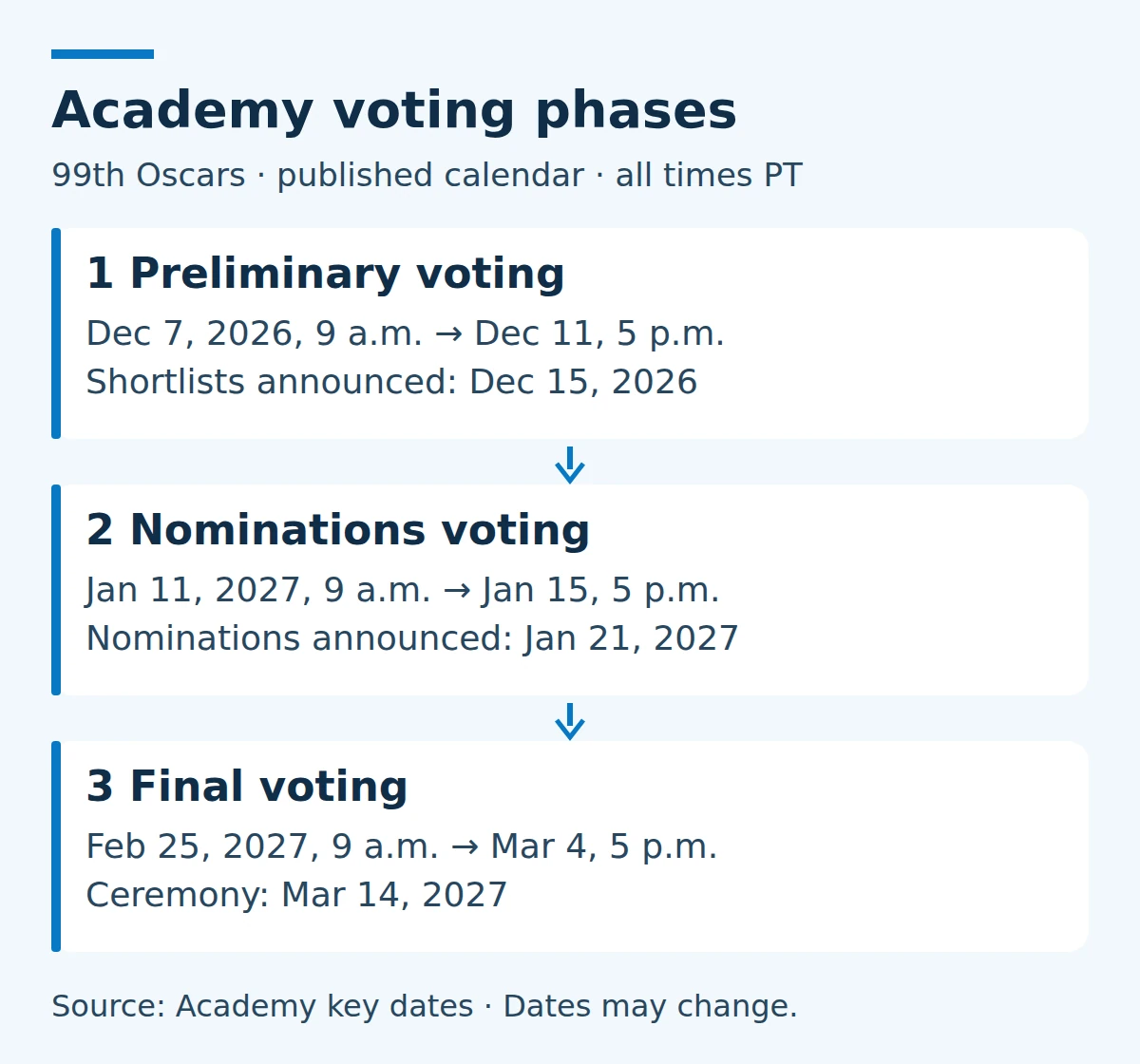
Preliminary voting comes next on the published calendar; nomination voting and final voting follow as separate rounds. The Academy’s key dates, checked October 19, give the sequence below. Times are Pacific Time, and the Academy says dates are subject to change.
| Phase | Published date | What to change in a prediction record |
|---|---|---|
| Preliminary voting | December 7, 2026, 9 a.m. to December 11, 5 p.m. PT | Track the round separately from nominations |
| Shortlists announced | December 15, 2026 | Record a shortlist place as a shortlist place |
| Nominations voting | January 11, 2027, 9 a.m. to January 15, 5 p.m. PT | Freeze the information available for a nomination forecast |
| Nominations announced | January 21, 2027 | Replace the provisional field with the actual nominees |
| Final voting | February 25, 2027, 9 a.m. to March 4, 5 p.m. PT | Track winner forecasts against this voting window |
| Ceremony | March 14, 2027 | Compare the final forecast with announced results |
An October watchlist can help organize viewing, but it cannot be labeled an official nominee list. Similarly, a shortlist announcement is a narrowing of a field rather than the final ballot. Keep those labels visible when saving a forecast or comparing pundits.
When do PGA, DGA and Actor Awards/SAG checkpoints arrive?
The guild calendars place their film nominations before the Academy’s nomination announcement, but their ceremonies after Academy nomination voting closes. Read the film rows specifically: television categories can have different dates.
| Film precursor | Nominations scheduled | Ceremony scheduled | Position against Academy voting |
|---|---|---|---|
| DGA theatrical feature | January 7, 2027 | January 30, 2027 | Ceremony after nominations are announced, before final voting opens |
| PGA theatrical motion pictures | January 8, 2027 | February 27, 2027 | Ceremony during Academy final voting |
| Actor Awards, presented by SAG-AFTRA | January 6, 2027 | February 28, 2027 | Ceremony during Academy final voting |
Sources: DGA annual awards schedule, PGA’s April 7, 2026 release and the Actor Awards calendar, all checked October 19, 2026. “SAG” remains a familiar search term for the Actor Awards.
The distinction matters when assessing a forecast’s record. A prediction made before guild nominations does not have the same information as one made after the ceremonies. Save the timestamp with the pick, rather than comparing both as if they were made at the same point in the race.

How can a precursor mislead a prediction?
A precursor becomes misleading when its category or timing is changed in the retelling. The prevention is to preserve what the award actually says and when the result became available.
| Signal | Appropriate use | Dominant Failure Mode & Prevention |
|---|---|---|
| PGA theatrical award | Examine a film’s producing recognition alongside a Best Picture forecast | Treating a guild choice as an Academy result; keep separate columns for each organization |
| DGA theatrical feature award | Examine the directing race | Automatically carrying the director’s result into Best Picture; make a separate film-level decision |
| Actor Awards individual performance | Examine the corresponding performance race | Carrying recognition across different roles or categories; record the exact category |
| Actor Awards cast recognition | Examine ensemble recognition | Treating a cast award as an individual acting award or a guaranteed Best Picture outcome; preserve the ensemble label |
| Any result received after a cutoff | Use it in a later, clearly dated forecast | Adding hindsight to an earlier forecast; retain the original version |
This is an editorial comparison of how to use information, not a measured success-rate table. The historical prediction guide has the separately sourced record; the calendar alone cannot assign a probability to any film.
What is the cutoff rule for a usable result?
A result must exist before the relevant ballot closes to be available to voters in that round. Threshold rule: if the result arrives at or after the voting deadline, exclude it from the evidence available before that deadline. A result during the voting window is available only from its announcement onward; it cannot explain ballots already cast.
For a date-level planning check, use:
Remaining calendar days = Academy final-voting closing date − precursor ceremony date.
Worked example — PGA: March 4, 2027 − February 27, 2027 = 5 calendar days. Those inputs come from the Academy and PGA calendars above. This is an elapsed-date calculation, not five complete days of voting after the result: the Academy deadline is 5 p.m. PT, and a ceremony’s announcement time also matters.
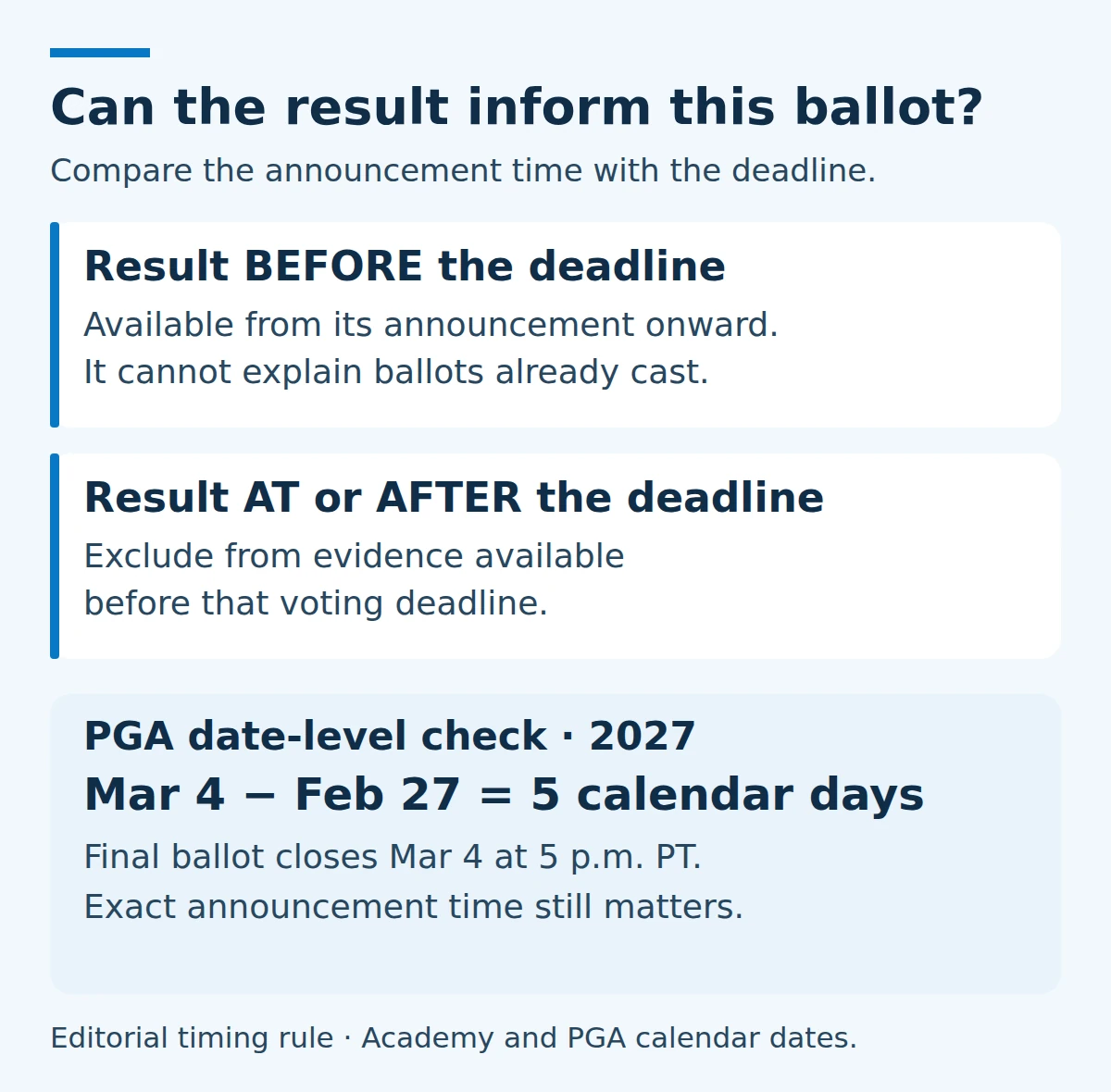
A negative result would flag a ceremony after the closing date. A zero result would require an exact time check. Neither calculation measures how much influence an award has; it only locates the information in time.
How much attention does this calendar deserve?
Use announcement checkpoints to decide when to revisit a forecast. Before nominations, organize the viewing list and record each film’s status. At the Academy nomination announcement, remove ineligible picks from the winner ballot. At guild ceremonies, update only the categories for which the new result adds relevant evidence.
The hidden cost is repeated research and viewing time. Rewriting the same pick after every discussion thread uses attention without necessarily adding information. Keep a compact record with the category, pick, date and source; add a reason only when new evidence changes the decision. If arranging an awards-night activity, the Oscar pool ballot and party guide is the next planning step.
Method and sources
Updated October 19, 2026. Dates were checked against the Academy’s calendar and completed ceremony page, DGA’s theatrical feature schedule, PGA’s dated calendar release and the Actor Awards calendar. The timeline overlay, cutoff rule and elapsed-day calculation are editorial analysis of those published dates. Images illustrate viewing and film crafts; they do not document an Academy or guild venue. Recheck the organizations’ linked calendars before relying on a deadline.