
Reading one television episode as an Oscar ballot uses the wrong entry and the wrong count. The wrong entry misses the series, and the wrong count names a winner the ballot did not produce.
An Emmy comedy or drama series needs six episodes. Writing and directing for that series are one episode. An Oscar feature is a theatrically released motion picture longer than 40 minutes, and a television airing does not meet that qualifying run. Emmy category awards go to the highest vote. Oscar nominations are preferential or reweighted range votes, capped at five except ten for Best Picture.
The category map for the 78th Emmys sits on the nominations explainer. This page is the ballot and the entry unit.
Two ballots, two failure modes
| Ballot | What is counted | Dominant failure | Prevention |
|---|---|---|---|
| Emmy category | Highest vote, one winner | Treating a yes/no area as a head-to-head | Check whether the award is a category, an area, or juried |
| Emmy area | Each nominee on its own; 90 percent approval | Expecting exactly one winner | Allow more than one Emmy, or none in picture editing and sound mixing below 50 percent |
| Emmy final | Yes/no, or one top pick, by peer group | Quoting a ranked Oscar ballot | Use the system that peer group chose |
| Oscar nomination | Preferential or reweighted range | Counting a first-place pile as the nominee list | Cap the field at five, or ten for Best Picture |
| Oscar final | Plurality or preferential | Assuming every final is “most votes” | Read the category rule; viewing every nominee is required |
| Oscar-nominated program | Ineligible for an Emmy entry | Entering the same program in both | Rule 8c blocks an Emmy entry after any Oscar nomination |
How each academy counts
Rule. If the Emmy award is a category, the highest vote-getter receives the Emmy, and there is one winner. If it is an area, each nominee is judged alone: 90 percent approval wins, and if nobody reaches 90 percent the highest approval wins. Picture editing and sound mixing add a floor. Below 50 percent approval, that area can give no Emmy.
The final round, August 17 to August 26, 2026, is not one method for every peer group. The rules say judging can be a yes/no vote on whether the nomination is worthy, or a single vote for the top selection. A nominee cannot vote in a category where they are nominated. A tie in that final round is broken by which tied nomination had more voter approval on the first-round nominating ballot.
National Active members from all peer groups vote on program categories, except animated and documentary programs. Individual achievements stay with peer judging. Nominated comedy, drama, and short-form series must submit any six eligible episodes for that final judging. A two-part episode counts as two.
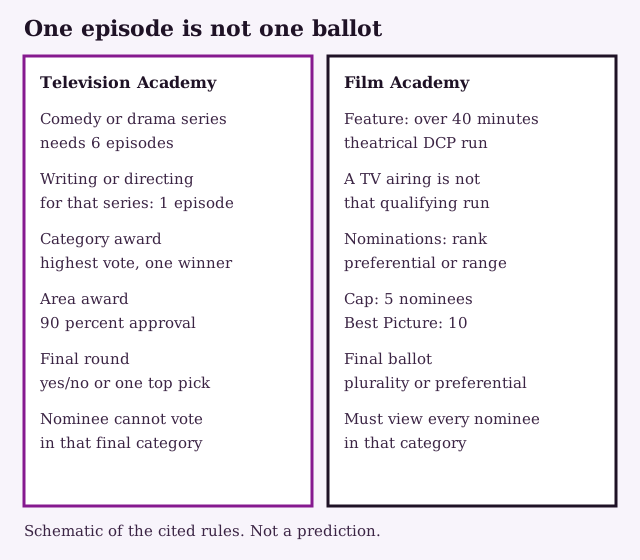
Oscar Rule Five restricts voting to active and life members. Nominations are marked and tabulated by the preferential or reweighted range system. Final ballots are tabulated by the plurality or preferential system. Write-in votes on the final ballot are not counted. Not more than five nominations are made for each award, except Best Picture, which has ten. A member must view all nominated films in a category to vote in it in the final round.
Best Picture nominations have their own sentence in Rule Twenty. All active and life members vote in order of preference for not more than ten motion pictures, and the ten receiving the highest number of votes become the nominees. Rule Twenty then limits final voting to active and life members. It does not, in that section, say the final is the same “highest number of votes” step. A prediction that treats every Oscar final as a first-place pile is ahead of the rule text. The precursor method is for picks after nominees exist. It is not this count.
What a single episode can enter
Rule. If the award is Outstanding Comedy Series or Outstanding Drama Series, the entry is the series, and a minimum of six episodes must air in the eligibility year. If the award is writing or directing for a comedy or drama series, the entry is one episode.
A new series that premieres in the year and does not reach that episode count does not get a workaround by submitting the writing episode early. Rule 11c says the series and its individual achievements gain eligibility in the next Emmy competition.
An established series that is cancelled, and that first airs five or fewer episodes in the current year, is ineligible for the program category. Body-of-work entries are also out for those orphaned episodes. The rules name lead and supporting performers, writing for a variety series, and casting among those body-of-work entries. A category whose heading is “for a single episode” still has to meet that category’s own rule. It is not automatically a series award.

Guest performers are a third unit. They must appear in less than 50 percent of the eligible episodes, and the entry is one episode. The minimum stand-alone, contiguous screen time is 5 percent of that episode. On a 40-minute episode, that floor is
t = 0.05 × 40 = 2 minutes
Forty minutes is an example runtime, not a rule. Lead performers are entered for a continuing performance in the series, not for that one episode. The entrant chooses lead, supporting, or guest, but a performer in 50 percent or more of the episodes cannot use the guest category.
Limited-series directing and writing split by credit. A director or writer credited on every part is eligible for the complete series. Credit on one part is eligibility for that part. Credit on more than one part, but not all, means the entrant chooses one part.
Animated programs are the exception that is nominated as a single episode even as a program. Only the producers, directors, and writers credited on the submitted episode are eligible. That does not move a live-action comedy series onto the same one-episode program rule.
Why a television episode is not an Oscar
Rule Two defines a feature as over 40 minutes, publicly exhibited as 35mm, 70mm, or a Digital Cinema Package in a commercial theater for paid admission. The rules say consumer, broadcast, streaming, and non-DCP files do not satisfy that Digital Cinema requirement. The qualifying run must begin between January 1, 2026, and December 31, 2026.
A 30-minute episode fails the feature-length test before the theater test. A 50-minute episode still fails if its only exhibition is television, because a television airing is not the qualifying run. This page does not turn an episode into an Oscar short. Short-film rules are a separate theatrical or festival path, and they are not met by calling a series episode a short.
The Emmy book closes the other direction. Any program nominated for an Oscar in any category is not eligible to enter the Emmy competition. A non-documentary film placed on the Academy viewing platform is treated as a theatrical motion picture and is ineligible for the Emmys.

Emmy final judging puts the delivery duty on the program: six episodes for a nominated comedy, drama, or short-form series. Oscar final voting puts the viewing duty on the member. A pool that copies one rule onto the other ballot marks voters eligible who were not, or episodes that were never the entry.
What a 2026 prediction cannot do
The nomination round in the Emmy rules is June 11 to June 22, 2026. A list of expected nominees published before or after those dates is not a ballot, and it does not change the six-episode gate or the five-nominee Oscar cap. This page does not name 2026 Emmy nominees or predict winners.
Use the nominations explainer for how many nominees a category receives. Use the Oscar pool ballot when the form is the film academy’s categories. The awards-season shelf is Awards Season.
Methods and sources
The episode counts, the yes/no and top-pick final, the 90 percent and 50 percent thresholds, the orphaned-episode rule, and the August 17 to August 26 final round are from the Television Academy’s 78th Emmy Awards Rules and Procedures, Version 4, updated April 7, 2026. The feature-length test, the theatrical DCP note, the preferential and plurality sentences, the five-and-ten nominee cap, and the Best Picture nomination ballot are from the 99th Academy Awards Complete Rules. The two-minute line is 5 percent of a 40-minute example. Nothing here is a nomination result.