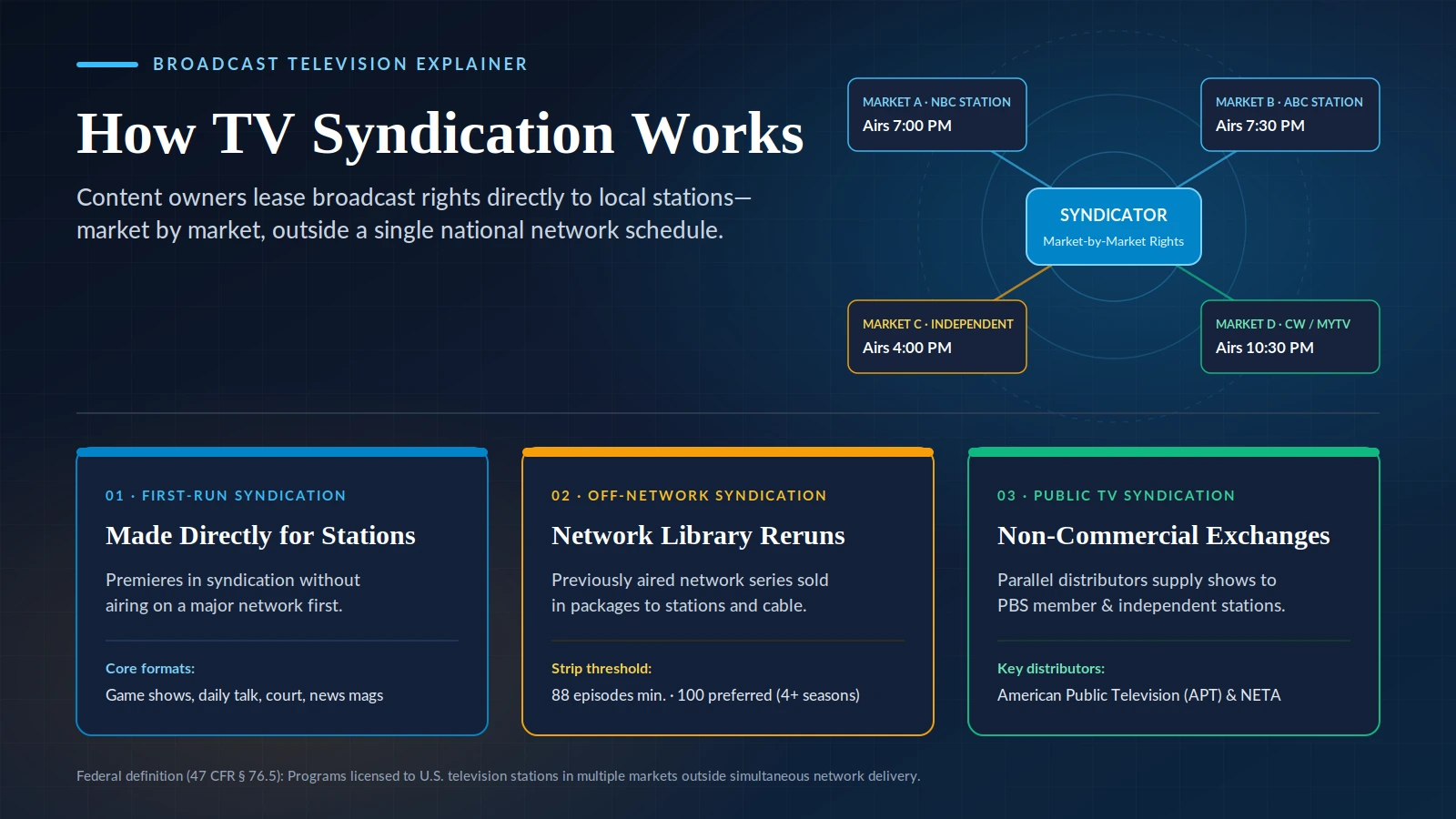
TV syndication is the practice of content owners leasing television broadcast rights directly to individual local stations or station groups across multiple markets without an official broadcast network airing the show. Instead of running simultaneously nationwide through one network feed, syndicated series reach viewers market by market through first-run, off-network, or public broadcasting distribution models.
Many viewers assume syndication simply means old network reruns, or confuse local station syndication with national streaming libraries. Separating how broadcast licensing works clarifies why a show like Jeopardy! can air on an NBC affiliate in early evening in one city and on an ABC station in another, while a classic sitcom repeats five nights a week on an independent channel.
What does TV syndication mean?
TV syndication means licensing television programming directly to multiple local broadcast stations across separate markets rather than delivering it simultaneously through a national broadcast network. Federal regulations draw a clear legal line between network feeds and syndicated shows, and television stations rely on three distinct syndication models to fill daytime, early-evening, and late-night slots.
Under 47 CFR § 76.5, a syndicated program is defined in paragraph (ii) as any program sold, licensed, distributed, or offered to television station licensees in more than one U.S. market other than as network programming. By contrast, paragraph (m) defines a network program as any program delivered simultaneously to more than one regional or national, commercial or noncommercial broadcast station.
That distinction shapes how local stations assemble their schedules across the day. Under federal cable definitions, a full network station generally carries 85 percent of weekly prime time hours offered by one of the major national television networks with which it holds primary affiliation, whereas an independent station carries not more than 10 hours of prime time network programming per week. Prime time itself is defined under 47 CFR § 76.5 as the 5-hour period from 6 to 11 p.m. local time (or 5 to 10 p.m. in the central time zone, with mountain time zone stations electing either window). Even affiliates of ABC, CBS, Fox, and NBC do not receive a full day of network programming, so local stations compete across local news, network feeds, and syndicated acquisitions—a structure detailed in the FCC Quadrennial Regulatory Review Final Rule.
| Syndication Category | Where Episodes First Air | Primary Local Outlets | Representative Formats and Distributors |
|---|---|---|---|
| First-run syndication | Premieres directly in syndication without airing on a broadcast network first | Major network affiliates in non-network hours and independent local stations | Daily game shows (Wheel of Fortune, Jeopardy!, Family Feud), stripped talk shows (Dr. Phil, The Kelly Clarkson Show), court shows (Judge Judy), and news magazines (TMZ Live) |
| Off-network syndication | Premieres first on a broadcast network (or in some cases first-run syndication) before local licensing | Independent stations, smaller network affiliates, and basic cable networks | Non-serialized sitcoms stripped five weekdays a week locally; hour-long dramas on weekends or basic cable channels |
| Public broadcasting syndication | Produced by or for non-commercial broadcasters and shared across public TV stations | PBS member stations and independent non-commercial public television stations | Parallel public-TV syndicators led by American Public Television (APT) and the National Educational Telecommunications Association (NETA) |
How does TV syndication work behind the scenes?
TV syndication works through market-by-market licensing contracts negotiated by a production company or specialized distributor called a syndicator. Rather than signing one master schedule deal with a national broadcast network, the syndicator clears individual stations or large station groups across local media markets using cash, barter, or hybrid ad-sharing terms backed by federal territorial exclusivity rules.
Station-group clearances and cash vs. barter contracts
When a broadcast network picks up a series, the show is normally guaranteed to run on most or all of that network’s affiliates on the same day of the week and in the same time slot within a time zone. In broadcast syndication, the syndicator instead attempts to license the show to one station per media market or to a commonly owned station group domestically and internationally.
To assemble national reach efficiently, distributors traditionally pitch first to seven major U.S. station groups—Nexstar Media Group, ABC Owned Television Stations, NBC Owned Television Stations, CBS News and Stations, Fox Television Stations, Telemundo Station Group, and Televisa Univision—securing clearances in major markets such as New York City, Los Angeles, San Francisco, and Philadelphia before expanding to smaller owners. Top-rated U.S. syndicated programs usually have a domestic market reach as high as 98%.
Three commercial contract structures govern how local stations compensate syndicators:
| Deal Structure | Upfront Cash Fee | Advertising Time Split | Typical Program Profile |
|---|---|---|---|
| Cash deal | Station pays cash as the highest bidder in its local market | Local station retains local commercial insertion rights | Proven, high-demand syndicated hits in competitive local markets |
| Cash-plus-barter deal | Station pays a reduced license fee to the distributor | Distributor retains part of the commercial inventory to offset licensing cost | Established syndicated series balancing cash fees with national ad reach |
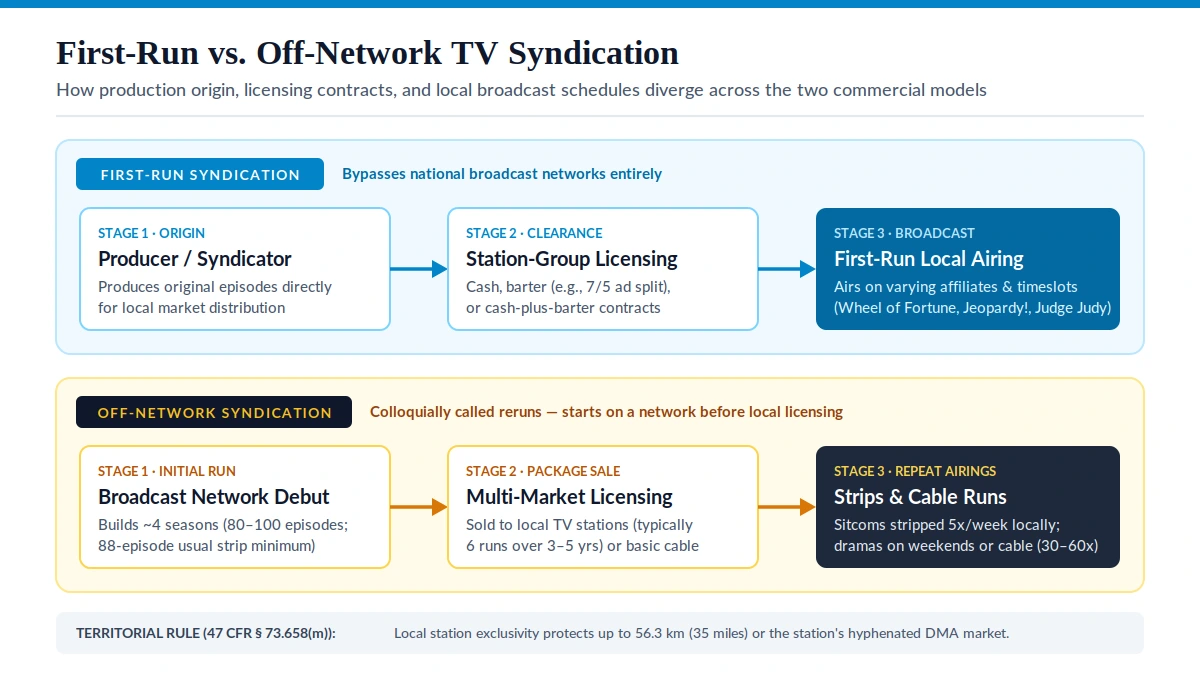
| Full barter deal | No upfront cash fee paid by the local station | Producer and station split commercial minutes—such as a 7/5 deal giving seven minutes to the producer and five minutes to the station | Newly launched, untested shows or older library titles |
The arrival of barter syndication dramatically expanded local independent television. Because stations no longer needed cash upfront to fill daytime and fringe schedules, the number of U.S. independent television stations grew from fewer than 100 in 1980 to 328 by 1986.
Federal territorial exclusivity and cable syndex rules
Because a local station invests cash or valuable ad minutes to acquire a syndicated hit, federal rules restrict rival stations and cable systems from undercutting that local market window. Under 47 CFR § 73.658, a U.S. commercial television station cannot sign a non-network contract that blocks another television station located more than 56.3 kilometers (35 miles) away from broadcasting the same program, except against stations licensed to another designated community inside a hyphenated market listed among the 100 markets in § 76.51 or current Nielsen Media Research DMA rankings. As a narrow exception under paragraph (m)(2), a station may contract for exclusive national rights under which no other U.S. television station may air the program.
Federal cable rules reinforce those private market agreements across pay-TV systems. Under 47 CFR § 76.101, once notified pursuant to § 76.105, a cable community unit inside a commercial station’s agreed syndicated geographic zone (bounded by § 73.658(m)) cannot carry that syndicated program from another broadcast signal. Under 47 CFR § 76.103, program distributors may also exercise syndicated exclusivity rights for one year from initial broadcast syndication licensing anywhere in the United States, except in areas already licensed. As noted in the Copyright Royalty Board’s Final Determination, these syndicated exclusivity—or syndex—rules allow local broadcasters and copyright holders to require cable systems to delete or blackout duplicate syndicated shows imported from distant signals. Under 47 CFR § 76.106, however, those deletion rules do not apply to cable systems serving fewer than 1,000 subscribers, nor to signals inside a station’s grade B contour or stations classified as significantly viewed under § 76.54.
What is first-run syndication, and how does it differ from off-network deals?
First-run syndication is original television programming produced specifically to premiere directly on local stations through syndication rather than airing on a national broadcast network first. Off-network syndication, by contrast, licenses shows that already debuted on a broadcast network—or occasionally in first-run syndication—so other local stations and cable channels can broadcast the library as reruns.
Modern U.S. first-run syndication grew sharply after federal broadcast policy shifted in 1971. That year, the FCC adopted the Prime Time Access Rule and the Financial Interest and Syndication Rules, removing one nightly prime time hour from network programming control and requiring networks to spin off their syndication arms as independent companies. Although regulators hoped local stations would produce their own local programs for that slot, station budgets led broadcasters to purchase syndicated shows instead—creating a lasting marketplace for first-run entertainment.
Over the following decades, first-run syndication became home to some of television’s longest-running franchises:
- Game shows: Created by Merv Griffin, Wheel of Fortune premiered in syndication in 1983 and the modern version of Jeopardy! debuted in 1984, joining Family Feud as perennial daytime and early-evening anchors.
- Daily talk, court, and entertainment news shows: Stripped talk shows such as Dr. Phil and The Kelly Clarkson Show, courtroom programs such as Judge Judy and The People’s Court, and entertainment newsmagazines such as TMZ Live anchor weekday local lineups.
- First-run scripted dramas: While less common today, first-run scripted series once thrived on independent stations; Star Trek: The Next Generation debuted in first-run syndication in 1987 and held the top spot among syndicated series throughout its seven-year run.
- Educational children’s blocks: Local stations continue licensing syndicated children’s shows to meet federal E/I obligations stemming from the Children’s Television Act of 1990, which requires broadcast stations to air three hours of educational children’s programming per week regardless of station format.
How does a TV show go into syndication?
A TV show enters syndication through one of two pathways depending on whether it is a first-run original or a returning network series. First-run programs pitch directly to major station groups to lock in large-market clearances before national rollout, whereas network shows first build a multi-season library—typically four seasons or 80 to 100 episodes—before studios license off-network rerun packages.
For scripted network comedies and dramas, syndication sits at the end of a long broadcast development pipeline. A series starts as a test episode and initial network pickup—covered in our explainer on what a TV pilot and series order involve—moves through TV upfronts and fall schedule buys, and must survive multiple broadcast seasons on the network grid explained in how fall TV schedules work. Once a series builds enough episodes, the studio licenses off-network packages to local stations and cable networks.
Those downstream deals carry major economic weight. Off-network syndication across direct-to-station, international, and internet licensing accounts for roughly half of a television program’s overall revenue stream alongside advertising, allowing successful series to cover initial production costs and turn a profit even if their initial network run lost money. Local broadcast syndication licenses typically cover six consecutive showings of a series across three to five years, while basic cable channels that acquire off-network dramas may air each episode 30 to 60 times.
Entering off-network syndication can also expand an audience well beyond a show’s original network ratings:
- Post-cancellation revival in popularity: The original Star Trek aired for three seasons on NBC from 1966 to 1969 with only modest ratings, yet grew into a worldwide phenomenon once local stations began airing it in off-network syndication.
- Lifting a currently airing network hit: Syndicating early seasons while a show remains in production can grow live network viewership rather than cannibalize it. For CBS’s The Big Bang Theory, off-network syndication—particularly on TBS—helped lift sixth-season first-run ratings, with the episode “The Bakersfield Expedition” becoming the series’ first broadcast to attract 20 million viewers.
Why are 100 episodes needed for strip syndication?
Around 88 to 100 episodes are traditionally needed for off-network syndication because local stations prefer strip syndication, airing one episode five times a week in the same daily time slot. A library of at least 88 episodes (roughly four network seasons)—and ideally a rounded 100 episodes—lets a station broadcast continuously for several months before repeating episodes.
When a station strips a sitcom Monday through Friday, a short one- or two-season series burns through its entire catalog within weeks, causing viewer fatigue as repeats cycle back immediately. That scheduling arithmetic explains why 88 episodes became the standard industry floor and 100 episodes remained the benchmark syndicators prefer. Genres with younger turnover audiences can operate on smaller blocks: children’s programming frequently uses a 65-episode block, which fills a 13-week daily cycle so each episode repeats only four times per year.
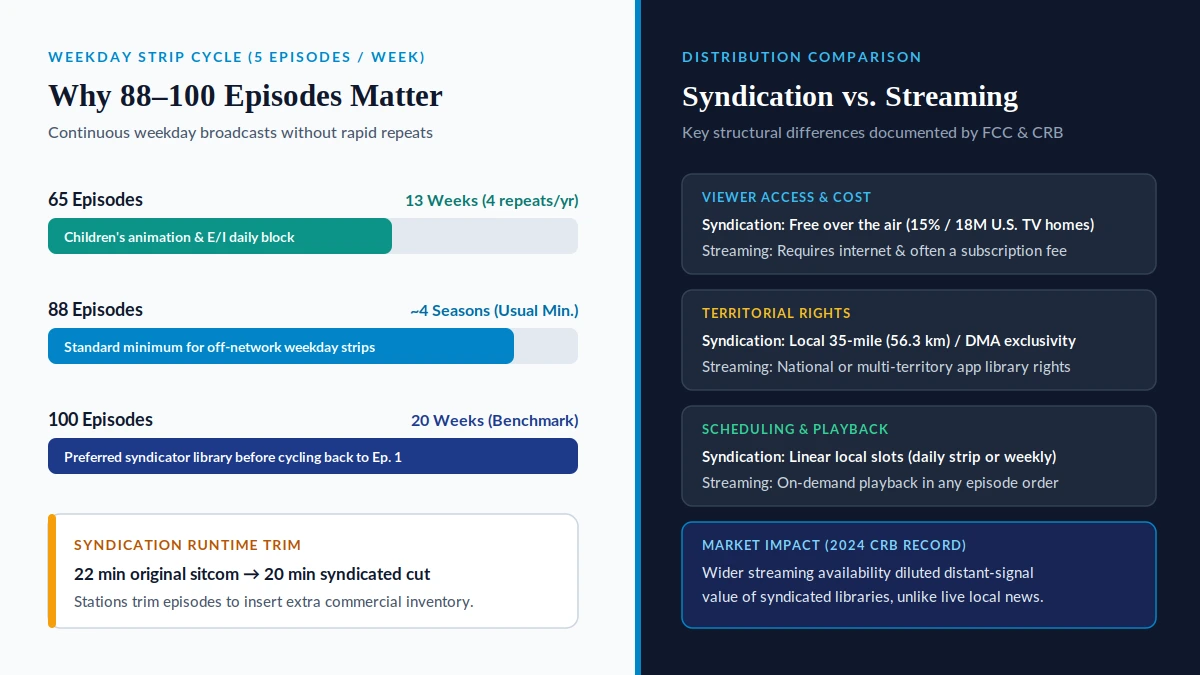
Format and episode length also affect how smoothly a series performs in daily strips. Non-serialized sitcoms work best on local stations because broadcasters can run episodes out of order without confusing casual viewers. Hour-long serialized dramas rarely work as weekday local strips and more commonly air weekly on weekends or move to basic cable networks. In addition, syndicated episodes frequently receive runtime trims to make room for additional commercials—a standard 22-minute American sitcom is commonly edited to 20 minutes for syndicated broadcasts.
Is TV syndication the same as reruns, and how does it compare with streaming?
TV syndication is not identical to reruns, and it operates under a different distribution model than on-demand streaming. Off-network syndication is colloquially called reruns, yet syndication also encompasses brand-new first-run shows and public-TV exchanges, while broadcast syndication delivers scheduled, geographically bounded over-the-air broadcasts rather than nationwide internet catalogs playable on demand.
Why syndication is broader than reruns
Every off-network syndicated broadcast is a repeat of an earlier run, which is why everyday viewers treat the two terms as synonyms. In television distribution, however, “syndication” describes the licensing channel—selling directly to stations outside a national network feed—not whether an episode is new or repeated. A brand-new episode of Wheel of Fortune, Jeopardy!, or Judge Judy is first-run syndicated television broadcast for the first time as a syndicated show. Likewise, non-commercial stations receive original and shared public-TV series through parallel public broadcasting syndicators such as American Public Television (APT) and the National Educational Telecommunications Association (NETA) alongside PBS.
Broadcast syndication vs. on-demand streaming
Streaming platforms have reshaped how viewers rewatch older network series, but federal regulatory records show that broadcast syndication and streaming remain structurally distinct delivery channels. In its Quadrennial Regulatory Review Final Rule, the FCC emphasized that cable, satellite, and streaming media all carry higher consumer costs because they require an additional service—such as internet access or pay-TV service—and often a subscription fee. Broadcast television, by contrast, remains free over the air, with estimates cited by the FCC indicating that 15% of U.S. television households (18 million households) rely on free over-the-air reception. The FCC’s record also found that online video largely complements rather than replaces broadcast television, with some live-TV streaming services incorporating local broadcast channels into their linear lineups.
At the same time, federal royalty proceedings document clear overlap where library reruns are concerned. In the Copyright Royalty Board’s Distribution of Cable Royalty Funds Final Determination—which classifies syndicated series, specials, and movies licensed to U.S. commercial TV stations under Program Suppliers—testimony noted that syndicated series and movies that historically ran exclusively on broadcast stations became increasingly available on streaming platforms. Based on that record, the Copyright Royalty Judges found credible evidence that broader streaming availability diluted the relative distant-signal broadcast value of syndicated Program Suppliers content, whereas original live local news was generally not diluted by streaming.
| Feature | Broadcast TV Syndication | On-Demand Streaming Licensing |
|---|---|---|
| Licensing geography | Market-by-market station or station-group deals bounded by up to 56.3 km (35-mile) or hyphenated DMA territorial exclusivity under 47 CFR § 73.658(m) | Platform-wide licensing across a national or multi-territory streaming app catalog |
| Viewer cost and access | Receivable free over the air with an antenna (used by an estimated 15% of U.S. TV households, or 18 million homes) as well as via pay-TV carriage | Requires internet service and often an active subscription fee |
| Schedule and episode order | Linear time slots chosen by each local station (daily weekday strips or weekly airings), often running sitcoms non-sequentially | Viewer-selected playback at any hour in sequential or chosen order |
| Regulatory blackout rules | Protected against distant cable imports by federal cable syndex rules under 47 CFR §§ 76.101–76.106 (with exceptions such as systems under 1,000 subscribers) | Governed by private platform licensing contracts rather than cable syndex deletion rules |
| Runtime and ad formatting | Sitcoms commonly trimmed from 22 minutes to 20 minutes to accommodate local and barter commercials | Full original episode runtimes delivered ad-free or with platform-inserted digital ads |
Viewers checking why a local station’s syndicated schedule differs across regions can pair this explainer with our guide to US TV premiere times and time zones, learn how pay-TV signal blackouts differ from syndex in our carriage dispute explainer, or browse more television industry guides across TV Reviews and the full blog archive.