Calling a sequel original because the dialogue is new puts the film in the wrong Oscar writing category. For the 99th Oscars, adapted is the general classification for credited existing material, and original is the general classification for a writer’s own fiction, unpublished work, or a true story researched from multiple sources.
The difference is the source the Writers Branch uses, not how closely the scenes match a book. Film submissions do not choose Original or Adapted. The Academy’s screenplay FAQ, document dated May 20, 2026 and retrieved October 13, 2026, says the Writers Branch Executive Committee reviews legal billing and decides the category. In general the Academy defers to the Writers Guild of America classification, unless there is no WGA classification or that classification has been called into question.
- Adapted, under the FAQ’s general rule, covers credited intellectual property, sequels, remakes, pre-existing characters, and previously published work.
- A true story is not one category by default. A credited source points to adapted. The writers’ own research from multiple sources points to original.
- A short film, a game, or a toy can fall on either side. The split is whether the short was exhibited as a finished work, and whether the game or toy has characters or a narrative.
- The committee’s final decision is the category. After that decision, appeals and extra materials are not accepted.
- This page does not name nominees, winners, or box office.
The desk faces a blank screen because this check uses the credits and the source type. A frame from the film does not show the category.
What is the difference between an original and an adapted screenplay?
An original screenplay and an adapted screenplay are the two Writing classifications in the 99th rules. Rule Twenty-four, in the rules PDF dated July 1, 2026, gives an award for the best achievement in each category. The names in that rule are Adapted Screenplay and Original Screenplay. The screenplay FAQ’s general guidelines separate them. A line-by-line comparison with a book does not.
Adapted is the general classification when the film is based on intellectual property listed in the credits, or on previously published work. The published-work list includes novels, nonfiction books, articles, plays, and short films, including the screenwriters’ own exhibited work. It also includes television shows, comic books, games, toys, podcasts, poems, and songs. A historical subject or true story based on a credited source, such as a book, documentary, or article, is generally adapted as well.
The same FAQ puts “a sequel, remake, film, documentary, and pre-existing characters” in one adapted bullet. It does not say whether one of those is enough or whether they must appear together. A sequel, a remake, or pre-existing characters is enough to start on the adapted side. If the credits only partly match that bullet, leave the label unresolved for the committee.
Original is the general classification when the writer created an original fictional film, when the writers are adapting their own unpublished or unproduced work, or when a true story comes from the writer’s own research using multiple sources. A myth or legend is generally original when it is not tied to one published version. A game or toy with no characters and no narrative is generally original. The FAQ’s example of that kind of source is Battleship. A short film made as a proof of concept, and not shown as a finished work, is generally original.
Takeaway: Adapted, in this FAQ, does not mean the script copied the source scene by scene. New dialogue in a sequel does not move that film to original.
Who decides the Oscar writing category?
The film does not submit into Original or Adapted. The Writing Awards administration cannot determine or suggest a category. The Writers Branch Executive Committee reviews the legal billing for eligible titles and resolves questions of category and eligibility.
In general, the Academy defers to the WGA category classification. Two exceptions move the question onto the FAQ guidelines: there is no WGA classification, or the WGA classification has been called into question. The FAQ does not say who can raise that question, or what evidence the challenge needs. Until the committee decides, the category stays unresolved.
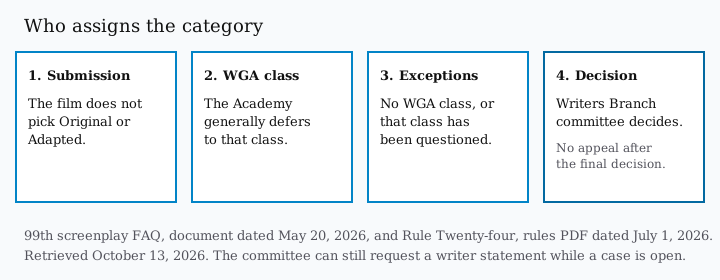
The order is the FAQ’s order. A WGA classification is the starting point, and the two exceptions are the only departures the FAQ names.
Rule Twenty-four adds tests that both categories share. Either category requires an explicit screenwriting credit in the film’s legal billing, and the screenplay must be human-authored. Credited production companies or other entities are ineligible. A final shooting script must be submitted as a PDF. The screenplay FAQ says that PDF is due on the general-entry deadline. The 99th date for that deadline sits on the calendar in how Oscar shortlists are scheduled.
After the category is set, Rule Twenty-four says reminder lists of eligible screenplays in each category go out with the nominations ballots to Writers Branch members. Those members vote in order of preference for not more than five screenplays in each category. The five screenplays in each category that receive the highest number of votes become the nominations. Final voting is limited to active and life Academy members. The writing rule we read does not describe a preliminary shortlist. Categories that do use one are on the shortlist page.
Takeaway: A viewer’s reading of the guidelines is a working label. The committee’s decision is the category.
When is a screenplay generally classified as adapted?
Use the adapted rows when the credits or the source match the May 20, 2026 FAQ. “Generally” is the Academy’s word. A matching row is not proof that the committee has already classified that film.
| Situation | General classification | What has to be true | What it does not mean |
|---|---|---|---|
| Intellectual property in the credits | Adapted | The credits list the intellectual property the film is based on | The script copied that property line by line |
| Sequel, remake, film, documentary, or pre-existing characters | Adapted | The FAQ groups these in one bullet | The FAQ says one item is enough on its own, or that all of them are required |
| Previously published work | Adapted | The source is published work such as a novel, nonfiction book, article, play, exhibited short (including the screenwriters’ own), television show, comic, game, toy, podcast, poem, or song | Every game and every short film is adapted |
| True story with a credited source | Adapted | The historical subject or true story is based on a credited book, documentary, article, or similar source | Every true story is adapted |
The published-work row and the original rows below use the same words, “short film” and “game,” for different facts. An exhibited short, including one the screenwriters made, sits with published work. A game or toy that has characters or a narrative sits there too. The narrower original rows come next.
When is a screenplay generally classified as original?
| Situation | General classification | What has to be true | What it does not mean |
|---|---|---|---|
| Myth or legend | Original | It is not based on one particular published version | Any film about a well-known story is original |
| Game or toy with no characters or narrative | Original | The source has neither characters nor a narrative. The FAQ’s example is Battleship | Every film based on a game is original |
| Proof-of-concept short | Original | The short was made as a proof of concept and was not shown as a finished work | The writers’ own exhibited short is original. The FAQ places exhibited shorts, including the screenwriters’ own, on the adapted list |
| Writers’ own unpublished or unproduced work | Original | The writers are adapting their own unpublished or unproduced work | Any earlier film by the same writers is original |
| True story from the writers’ own research | Original | The writer did the research and used multiple sources | A true story with a credited book, documentary, or article is original. That row is adapted |
| Original fiction | Original | The writer created an original fictional film | A sequel, or a film that uses pre-existing characters, is original |
The true-story pair is the row that gets collapsed most often. A credited source and the writers’ own research from multiple sources are different inputs. If the credits name a book, documentary, or article, the general rule is adapted. If the writers did the research and used multiple sources, the general rule is original. The FAQ does not say which row wins when both descriptions fit. That question belongs to the committee.
Takeaway: Read the credit line before you treat a true story as adapted or as original. The source type chooses the row.
How do you check the category?
The five-step category check produces a working label: adapted, original, or unresolved, plus the fact still missing. It does not produce the Academy’s classification.
- Read the credits for listed intellectual property or a named source. Listed intellectual property is generally adapted.
- If the film is a sequel, a remake, or uses pre-existing characters, keep the working label on the adapted side. New scenes do not change that start. The FAQ’s single bullet also names “film” and “documentary” and does not say how many of those items are required, so a partial match stays unresolved.
- If it is a historical subject or a true story, split the source. A credited book, documentary, or article is generally adapted. The writers’ own research from multiple sources is generally original.
- If the source is a short film, a game, or a toy, use the narrower row. An exhibited finished short is generally adapted, including the screenwriters’ own. A proof-of-concept short that was not shown as finished work is generally original. A game or toy with characters or a narrative follows the published-work row. One with neither is generally original. The FAQ’s example of a game or toy with neither is Battleship.
- Stop when two rows fit, when there is no WGA classification, or when that classification has been called into question. The Writers Branch Executive Committee decides. While a determination is under review, the FAQ says the committee may request a statement from the credited writers.
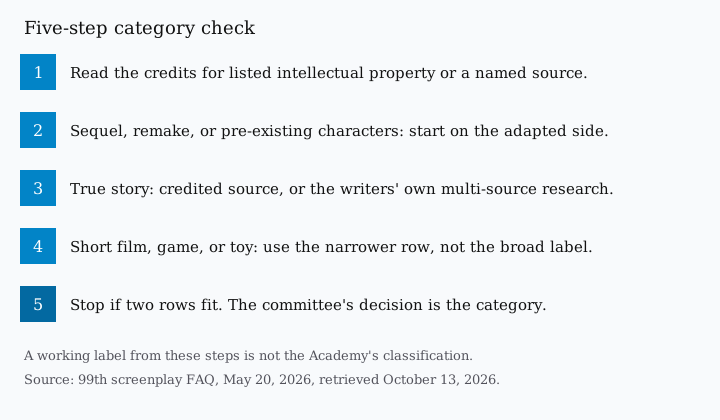
Takeaway: Leave the label unresolved when two rows fit. Do not fill the gap with a guess.
When these guidelines do not settle the category
The guidelines are not a viewer’s final call. Rule Twenty-four says the Writers Branch Executive Committee resolves questions of eligibility and rules. Once that committee has made its final decision, category appeals and additional materials are not accepted.
The same rows do not travel to another awards year on their own. They come from the May 20, 2026 screenplay FAQ and from Rule Twenty-four in the July 1, 2026 rules PDF, both retrieved on October 13, 2026. A later rules book replaces them.
This page does not teach screenplay format, page count, or pay, and it does not give copyright advice. It does not rank scripts, name nominees, or report box office. It does not assign a category to a film the committee has not classified. Predicting winners is a separate task, in how precursor awards lined up with Oscar winners. A ballot comes after nominations exist, which is what the Oscar pool sheet is for. Other 99th category rules, including what qualifies as an international feature, are not writing classifications.
More of these explainers are in the awards-season guides. This site is an independent publication. It is not the Academy, the Writers Guild, or a studio. How the site is produced states that boundary.
Method and sources
This page was compiled on October 13, 2026 from two Academy documents retrieved that day. The screenplay submission FAQ is a three-page PDF with document properties dated May 20, 2026. The classification guidelines are the section that asks how adapted and original classifications are determined. The 99th Academy Awards complete rules PDF has document properties dated July 1, 2026. Writing is Rule Twenty-four, and the two classifications are also named in the awards list at the front of that book. The tables and the five-step check paraphrase those sections. The FAQ text is not reprinted. Battleship appears because the FAQ uses it as an example of a game or toy with no characters or narrative. Nomination totals, winners, and box office are not in these documents and are not added here. The photograph shows one desk and a blank screen so the check stays on the credits. The two diagrams repeat the decision order and the five steps already written above. Search volume was not measured.
Related reading
- How Oscar shortlists work covers the 99th calendar and the categories that have a preliminary cut. Rule Twenty-four uses reminder lists with the nominations ballots.
- How to predict Oscar winners is for precursor results after a category exists. It does not classify a screenplay.
- Oscar pool ballot is the sheet for picks after nominations are announced.
- Awards-season guides collects the Oscar and Emmy explainers on this site.