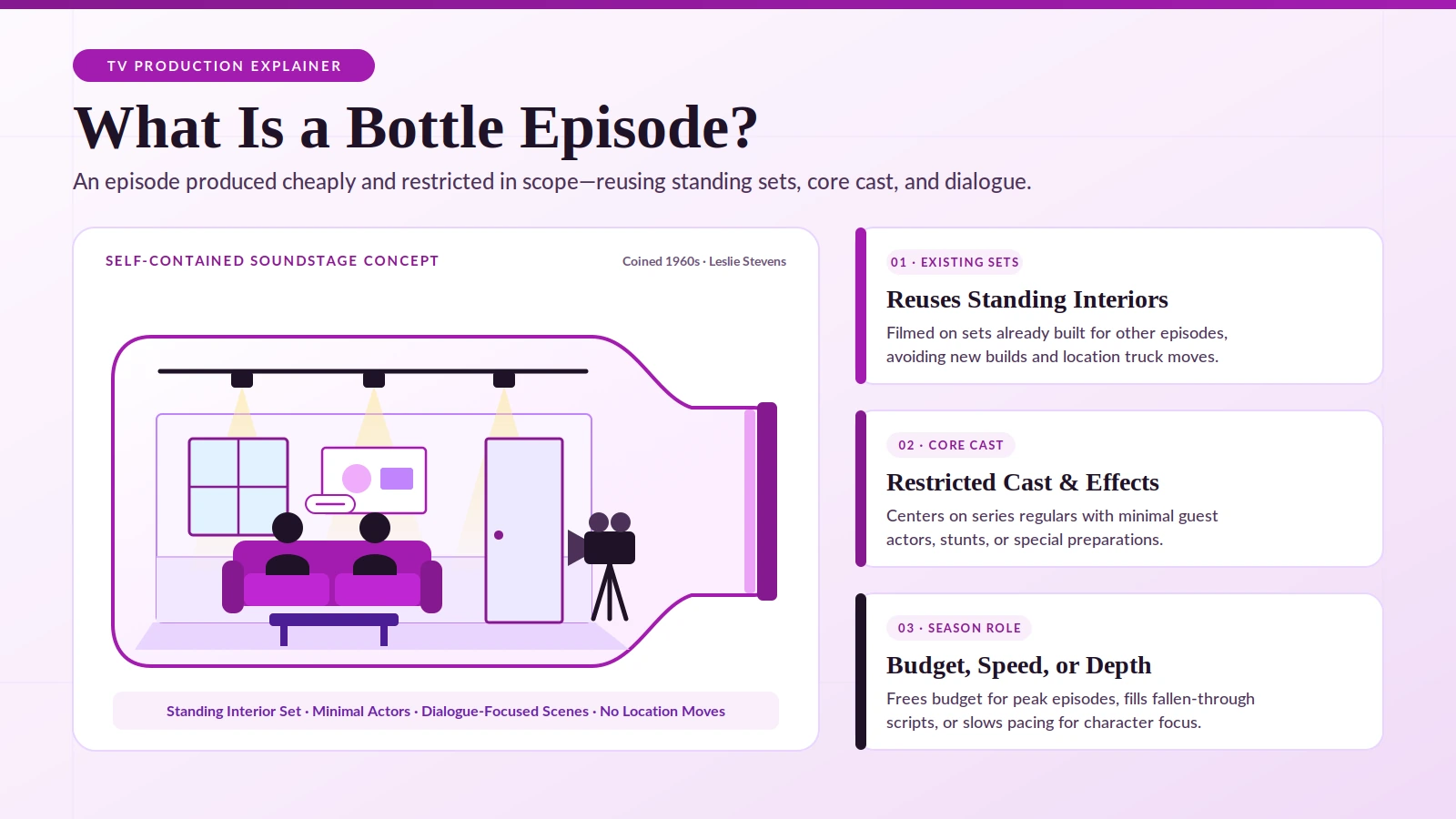
A bottle episode (or bottle show) is an installment of episodic television produced cheaply and restricted in scope to use as few actors, effects, and sets as possible. Usually filmed on standing main interior sets built for other episodes, bottle episodes rely on dialogue to save season budget, cover short-notice script gaps, or deepen character exploration.
Viewers often mistake any slow-moving or single-room television installment for a bottle episode, or lump bottle shows together with filler episodes and clip shows. Understanding how production scope defines the term clarifies why series ranging from classic network sitcoms to serialized cable dramas turn to this format across a season.
Why is it called a bottle episode?
The term began as “bottle show” in the 1960s, coined by Leslie Stevens, creator and executive producer of the television series The Outer Limits. Stevens used the phrase for an episode made in very little time at very little cost, comparing it to pulling an episode right out of a bottle like a genie.
That genie-in-a-bottle image explains why the label refers to production economy rather than a literal prop on screen. As documented in the reference overview of the bottle episode format, variants of the phrase have occasionally appeared as literal episode titles on American television series without following the bottle-episode production model at all.
At least three American television episodes have used variants of “Bottle Episode” as titles for stories involving physical bottles rather than restricted-scope shoots:
- Supergirl (“The Bottle Episode”, 2020): Set in the DC Comics multiverse and centered on Brainiac, a supervillain who shrinks cities and stores them in bottles.
- The Simpsons (“Bottle Episode”, 2024): Built around a plot involving bottles of wine rather than a stripped-down standing-set shoot.
- Harley Quinn (“Bottle Episode (But Not a ‘Bottle Episode’)”, 2025): Another DC Comics multiverse installment involving a version of Brainiac and bottled cities.
What are bottle episodes for in television production?
Television producers use bottle episodes for three practical reasons: shifting season budget toward more expensive installments, replacing a script that has fallen through on short notice, and creating deliberate dramatic focus. Because standing interior sets and dialogue require no special preparations, a bottle installment trims locations, guest casting, and effects work.
Budget reallocation is the classic driver across multi-episode television orders. Star Trek: The Next Generation used bottle episodes so the production could spend more on special effects in other episodes. Scott Brazil, executive producer of The Shield, described bottle episodes as “the sad little stepchild whose allowance is docked in order to buy big brother a new pair of sneaks.” Likewise, when Breaking Bad went over budget during its third season, creator Vince Gilligan explained that the production needed to come up with a bottle episode set in one location.
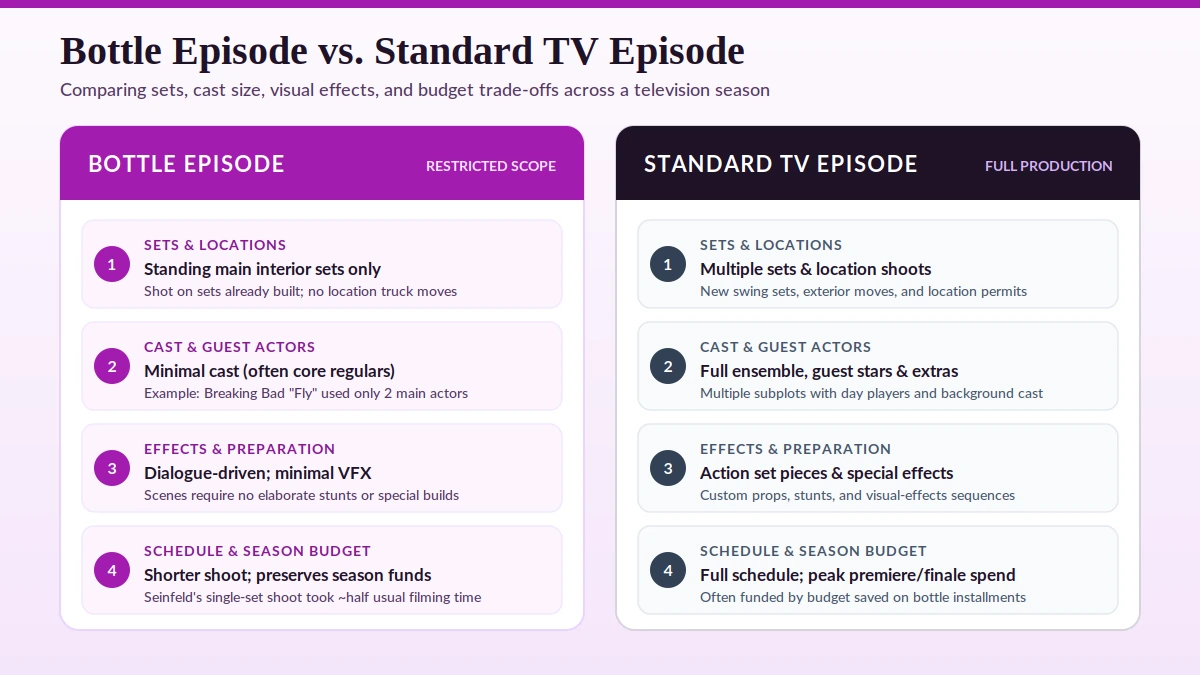
Creative pacing works alongside those financial realities. Because a restricted setting and smaller cast slow down the action, writers can pause external spectacle and examine character traits and motives in close quarters. Gilligan noted that even apart from financial realities, quiet episodes give a season shape and pace so that big dramatic moments of action and violence late in the season land harder by contrast. For how series leadership coordinates those season-wide trade-offs with line producers and writers’ rooms, see our guide to what a showrunner decides.
| Production Factor | Bottle Episode | Standard TV Episode |
|---|---|---|
| Sets and locations | Usually shot on existing main interior sets built for other episodes | Multiple sets, new builds, or on-location shoots |
| Cast scope | As few actors as possible, centered on the core cast | Full ensemble plus guest actors and background cast |
| Effects and preparation | Largely dialogue and scenes requiring no special preparations | Special effects, stunts, or elaborate set-piece preparation |
| Filming time impact | Can shorten shooting substantially (Seinfeld’s single-location shoot took roughly half the usual filming time) | Full multi-location or multi-set shooting schedule |
| Season-level purpose | Preserves budget for costlier episodes, covers a fallen-through script, or slows pace for character depth | Carries standard or peak action, multi-plot storylines, and larger production scale |
What are famous bottle episode examples?
Famous television bottle episodes span network sitcoms, serialized cable dramas, and ensemble comedies, including Seinfeld’s “The Chinese Restaurant” (1991), Friends’ “The One Where No One’s Ready” (1996), Breaking Bad’s “Fly” (2010), and Community’s “Cooperative Calligraphy” (2010). Other notable series with bottle episodes include Star Trek: The Next Generation, The West Wing (“17 People”), Doctor Who, Parks and Recreation, Frasier, Family Guy, Mad About You, Archer, Girls, Mongrels, BoJack Horseman, Grey’s Anatomy, Atlanta, and Chicago Fire.
Sitcom real-time classics and metafictional spins
On May 23, 1991, NBC aired Seinfeld’s 11th episode of its second season (16th overall), “The Chinese Restaurant,” co-written by Jerry Seinfeld and Larry David and directed by Tom Cherones. Set entirely inside one Chinese restaurant in real time across 23 minutes without scene breaks, the episode focused on Jerry, Elaine, and George—marking the first of two episodes in which Kramer did not appear. Read by the cast on December 5, 1990 and filmed on December 11 at CBS Studio Center, the single-location shoot took roughly half the time usually required to film an episode. NBC executives initially objected that the script lacked an involved storyline and postponed broadcast until near the end of season two after David threatened to quit over forced changes, yet the broadcast achieved an 11.7 Nielsen rating (11.7% of American households) and a 21 audience share, ranking as the eighteenth most-watched show of the week and sixth on NBC.
Nearly two decades later, NBC’s comedy Community turned the production device itself into the joke—a blatant admission to utilizing the bottle episode of television writing noted in The Greene Street Review at NYU. The eighth episode of its second season (33rd overall), “Cooperative Calligraphy,” aired on November 11, 2010 as a metafictional bottle episode. When Annie notices her missing pen in the study room, the television-savvy Abed warns the group that they are about to enter a bottle episode, and Jeff explicitly announces a lockdown by declaring, “I’m doing a bottle episode.” The original NBC broadcast reached approximately 5.635 million households with a 2.0 rating and 6% share in the 18-49 demographic.
Serialized drama under budget pressure
Breaking Bad’s tenth episode of its third season (30th overall), “Fly,” aired on AMC on May 23, 2010, written by Sam Catlin and Moira Walley-Beckett and directed by Rian Johnson. In a Harvard Gazette conversation, Vince Gilligan called “Fly” his favorite episode and explained that it was a bottle episode written because the show was drastically over budget, with filming in one location saving money. The 47-minute installment restricts on-screen principal cast to just two actors—Bryan Cranston and Aaron Paul—apart from laundromat extras. Credited series regulars Dean Norris, Betsy Brandt, and RJ Mitte do not appear at all, while Anna Gunn’s voice is reused audio from the second-season episode “Phoenix.”
Viewer and critical reactions to “Fly” illustrate how polarizing a dramatic bottle episode can be. Its original broadcast drew 1.20 million viewers, down from 1.62 million for the preceding episode “Kafkaesque” and the second-lowest season-three debut just ahead of “Half Measures” (1.19 million). Yet Entertainment Weekly ranked “Fly” fifth among all 62 Breaking Bad episodes in 2013, and in 2019 The Ringer ranked it 14th of 62 while Vulture placed it 15th overall—even as Collider called it “the most polarizing episode” of the series in 2025.
| Series and Episode | Season / Overall & Air Date | Restricted Cast & Setting | Verified Production or Ratings Benchmark |
|---|---|---|---|
| Seinfeld — “The Chinese Restaurant” | Second season, 11th episode (16th overall); May 23, 1991 (NBC) | Single Chinese restaurant set; Jerry, Elaine, and George (Kramer absent); 23 minutes real time | Filmed in roughly half the usual shooting time; 11.7 Nielsen rating, 21 share (eighteenth for the week, sixth on NBC) |
| Friends — “The One Where No One’s Ready” | Third season, second episode (50th overall); September 26, 1996 (NBC) | Almost entirely Monica and Rachel’s living room; core cast of six plus three other speaking roles; 22 minutes real time | Conceived to save budget; voted third most popular Friends episode in a 2004 NBC poll |
| Breaking Bad — “Fly” | Third season, tenth episode (30th overall); May 23, 2010 (AMC) | Single lab location; two main actors appearing (Dean Norris, Betsy Brandt, and RJ Mitte credited but absent); 47 minutes | 1.20 million initial viewers (vs. 1.62 million prior week); ranked fifth of 62 by EW (2013), 14th by The Ringer (2019) |
| Community — “Cooperative Calligraphy” | Second season, eighth episode (33rd overall); November 11, 2010 (NBC) | Locked-down campus study room; core study group cast in metafictional premise | Reached approximately 5.635 million households; 2.0 rating and 6% share in adults 18-49 |
Does Friends have a bottle episode?
Yes: Friends produced one of television’s best-known bottle episodes with the second episode of its third season, “The One Where No One’s Ready” (50th overall), which aired on NBC on September 26, 1996. Written by Ira Ungerleider and directed by Gail Mancuso, it takes place almost entirely in Monica and Rachel’s apartment living room.
Executive producer Kevin S. Bright conceived the bottle-episode format for Friends as a way to save money for other episodes by using a single set and avoiding guest stars. Beyond the central cast of six, the episode features only three other speaking roles. It is also the only episode of Friends to unfold in real time, tracking the 22 minutes remaining before Ross’s museum function as his friends argue over outfits, voicemail messages, and a chair.
Even a single-set shoot can encounter unexpected production hurdles. During one take of the physical stunt in which Joey and Chandler race for the chair, Matt LeBlanc dislocated his shoulder, forcing production on the episode to pause until he recovered. Although the accident itself was not edited into the installment, the writers incorporated LeBlanc’s injury into the following two episodes by having Joey dislocate his shoulder while jumping on his bed.
Audience enthusiasm turned a cost-saving experiment into an annual series tradition. The episode was voted the third most popular Friends installment in a 2004 NBC poll and appeared on one of the earliest Region 1 best-of DVD collections. Its popularity led producers to create at least one bottle episode in every subsequent season, including “The One with Monica’s Thunder” and “The One on the Last Night,” which centered solely on the core cast of six.
Bottle episode vs. filler episode vs. clip show: what is the difference?
A bottle episode is defined by restricted production scope using newly filmed scenes, whereas a filler episode is defined by not progressing the plot (or padding a broadcast slot) and a clip show consists primarily of recycled excerpts from past episodes. Although these formats occasionally overlap, each solves a different television problem.
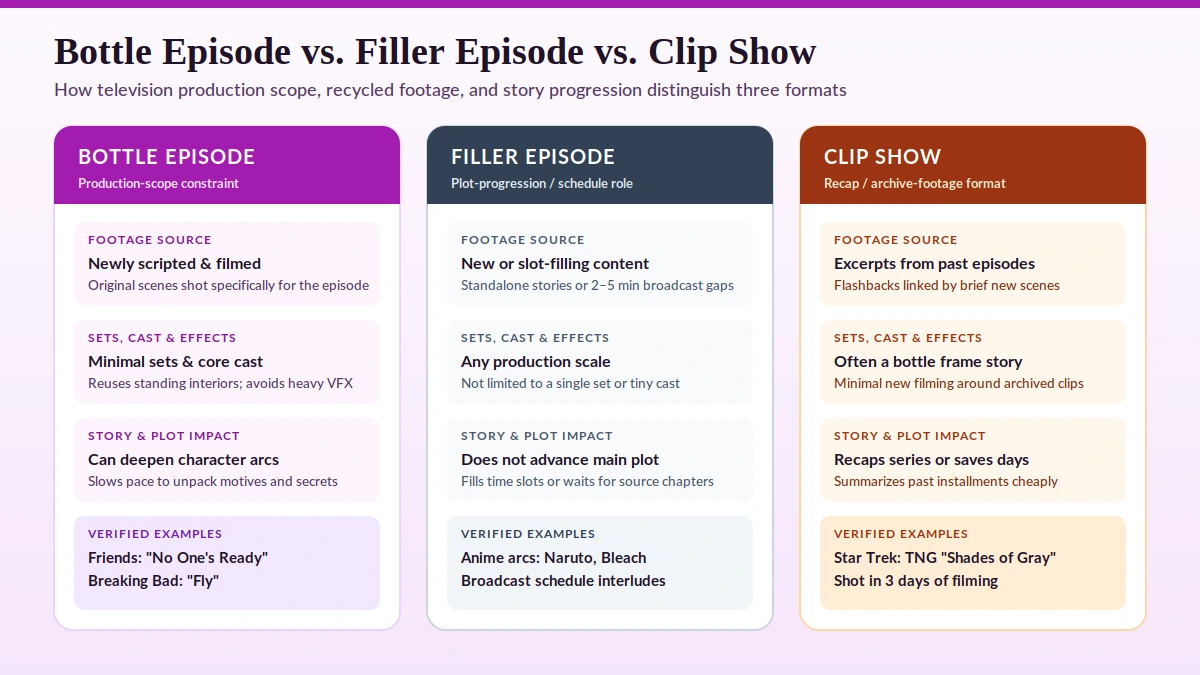
Bottle episode vs. filler episode
The core confusion comes from treating low-action character episodes as plotless filler. In reference definitions, filler is material of lower cost or quality used to fill a television or radio time slot, and a filler episode is specifically an episode that does not progress the plot. Broadcasters have also used short filler segments—such as music video clips running approximately 2 to 5 minutes before a scheduled show—while televised anime series such as Naruto and Bleach frequently add multi-episode filler arcs because anime broadcasts outpace the manga chapters they adapt.
By contrast, a bottle episode is a production method rather than a judgment on plot relevance. A bottle episode uses minimal sets, cast, and effects, yet its confined dialogue can uncover major character secrets or shift relationships—as when Breaking Bad’s “Fly” digs into Walt’s guilt over Jane or Community’s “Cooperative Calligraphy” exposes personal secrets across the study group. Conversely, an expensive filler episode with multiple sets and guest stars is still filler if it leaves the ongoing plot untouched.
Bottle episode vs. clip show and two-hander
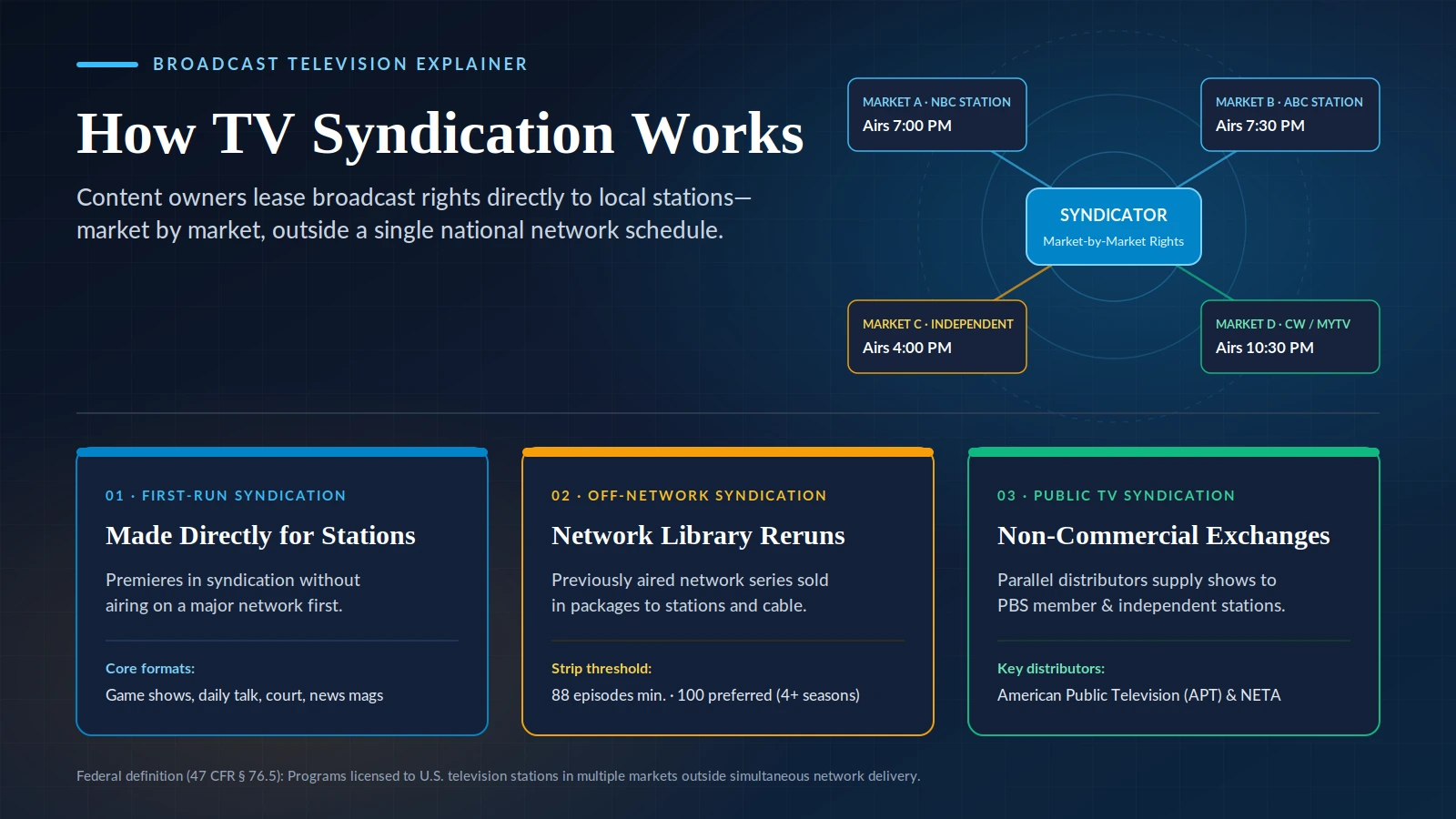
A clip show (or recap episode) consists primarily of excerpts from previous episodes, and most clip shows include a frame story in which cast members recall earlier events as flashbacks. That framing device is often shot like a bottle episode, which is why the two formats get conflated, and clip shows are likewise produced for budgetary reasons or to pad episode counts ahead of TV syndication. The format dates back to 1936 with the Republic Pictures serial Robinson Crusoe of Clipper Island, where weather delays led screenwriter Barry Shipman to add two recap chapters onto a 12-chapter budget. Similarly, at the end of Star Trek: The Next Generation’s second season, Paramount cut the final episode’s budget after an earlier episode ran over budget and over schedule, leaving only three days for principal photography and no spare scripts after a writers’ strike; the result was the clip show “Shades of Gray.”
Viewers also encounter the term two-hander, which refers to a drama with only two characters. A two-hander can double as a bottle episode when filmed cheaply on a single standing set—like “Fly” centering on Walt and Jesse—but the label describes cast size alone rather than budget constraints.
| Format | Primary Footage | Production Scope | Story & Plot Function | Verified Example |
|---|---|---|---|---|
| Bottle episode | All newly scripted and filmed scenes | Restricted to minimal sets, cast, and effects (usually existing interiors) | Saves budget, fills script gaps, or slows pace for deeper character exploration | Friends (“The One Where No One’s Ready”); Breaking Bad (“Fly”) |
| Filler episode | Newly filmed episodes or slot-filling broadcast material (including 2-5 minute music clips) | Any set, cast, or budget scale | Does not advance the main plot; fills time slots or waits for source chapters | Anime filler arcs in Naruto and Bleach |
| Clip show | Primarily excerpts from earlier episodes linked by a brief frame story | Often a bottle-episode framing scene with minimal new shooting | Recaps prior events, marks milestones, or cuts shoot days under severe budget/schedule cuts | Star Trek: The Next Generation (“Shades of Gray”, three-day shoot); Robinson Crusoe of Clipper Island (1936) |
| Two-hander | Newly filmed drama scenes | Strictly two characters; location and budget can vary | Concentrates dramatic conflict between two performers | Overlapping two-character television dramas |
What makes a good bottle episode—and how can viewers spot one?
A strong bottle episode turns its production constraints into narrative pressure, pairing a ticking clock or locked-room premise with dialogue that reveals character traits and motives. Because no exterior action sequences or guest subplots can carry the runtime, pacing structure and ensemble friction do the heavy lifting.
Three repeatable structural elements show up across acclaimed bottle episodes:
- A clear time constraint or confinement rule: In Seinfeld’s “The Chinese Restaurant,” staff writer Larry Charles added a one-night screening of Plan 9 from Outer Space to introduce a ticking-clock deadline inside Larry David’s 23-minute real-time wait. Friends used a 22-minute real-time countdown before Ross’s museum event, and Community locked the study group inside one room until Annie’s missing pen turned up.
- Character friction that deepens existing dynamics: Removing external plot distractions forces characters to confront grudges, anxieties, or hidden secrets—from Chandler and Joey’s escalating chair feud to Walt’s obsessive insomnia and unspoken regret over Jane.
- Deliberate contrast within a season order: Placed inside a full multi-episode run—the broader season arc that begins with TV pilots and series orders—a quiet, dialogue-heavy installment can make louder climaxes stand out later in the season, even if viewers expecting rapid plot twists find the slowdown polarizing.
Quick checklist to verify whether an episode is a bottle episode
Because a quiet pace or a single room alone does not guarantee an installment is a bottle episode, viewers can check five concrete signals before applying the label:
- Standing interior sets: Nearly all scenes take place on sets already built for earlier episodes rather than custom new builds or exterior location shoots.
- Minimal cast list: The episode relies almost entirely on core series regulars (or a tiny subset of them), with few or no guest stars and minimal background extras.
- Low effects and stunt footprint: Dialogue and character interaction carry the episode without elaborate special effects, action set pieces, or heavy preparation.
- Original filmed scenes rather than flashbacks: The runtime consists of newly shot material instead of recycled excerpts from past episodes (which would make it a clip show).
- Production context: Interviews, episode notes, or season credits confirm the format was chosen to rebalance season budget, cover a fallen-through script, or intentionally stage a stripped-down character study.
For more explainers on how television episodes are ordered, staffed, and scheduled across a broadcast season, explore our TV Reviews guides and the complete blog archive.