Treating premiere week as the whole fall TV schedule can cost you a later launch. Network prime-time rollout windows differ: the published fall 2026 plans place FOX’s main entertainment launches in September, CBS’s branded premiere week in October, and some NBC comedy returns as late as November.
The fall TV schedule is a set of overlapping network rollout windows, not a single start date. As of October 19, 2026, the official releases below place some premieres before this guide’s cutoff and other launches ahead. Use the network comparison to choose the next check, then verify the show’s date, regular slot and local feed. These are published plans, not an episode-by-episode record of what actually aired or a complete grid for every network.
For the annual process behind these releases, read how fall TV schedules work. This guide focuses on using the current rollout windows. More viewing explainers are in the article index.
How do the networks’ rollout windows compare?
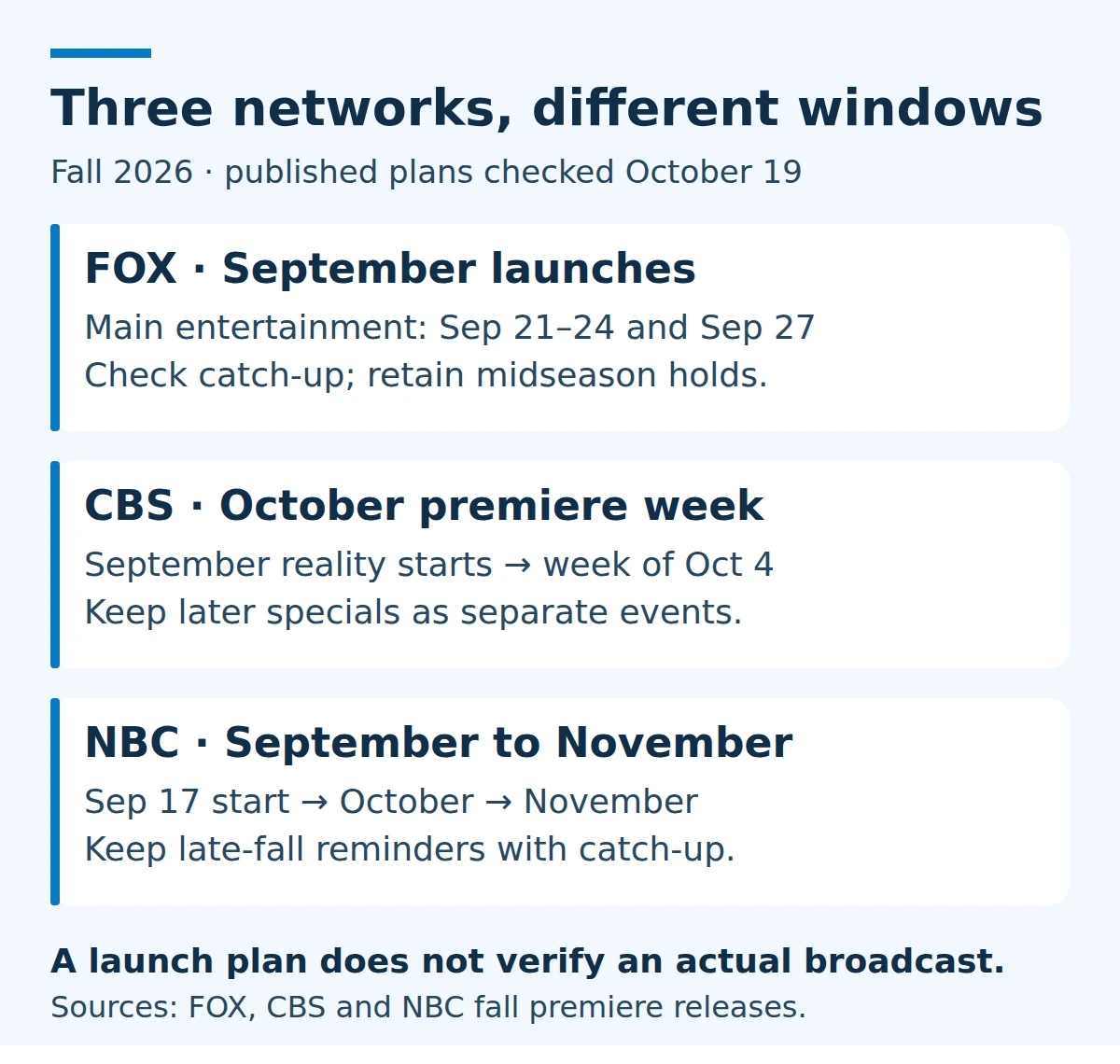
FOX, CBS and NBC publish different sequences, so one network’s premiere week cannot stand in for another’s. The table compares the official fall 2026 releases checked on October 19.
| Network | Published rollout window | Decision at the October cutoff | Dominant Failure Mode & Prevention |
|---|---|---|---|
| FOX | Main entertainment launches September 21–24 and September 27 | Check catch-up access for those starts; consult later listings for changes | Assuming every new series launches in September; check the release’s midseason holds |
| CBS | September reality starts lead into premiere week beginning October 4 | Separate the main launch week from later specials and regular-slot notes | Saving a one-off premiere time as a repeating reminder; read the regular-slot footnote |
| NBC | Entertainment starts September 17, drama returns in October, comedy returns into November | Keep late-fall reminders alongside catch-up plans | Treating September as the entire launch; retain each show’s own date |
Sources: FOX’s fall premiere release, CBS’s July 27 announcement and NBC’s June 24 announcement. Each window describes that network’s plan; it is not an industry-wide deadline.
The practical change is to file entries by their next action. A show whose announced premiere is behind the cutoff needs an availability check. An upcoming launch needs a dated reminder. A midseason hold without a day needs a later announcement, rather than an invented premiere date.
Which published windows still lie ahead?
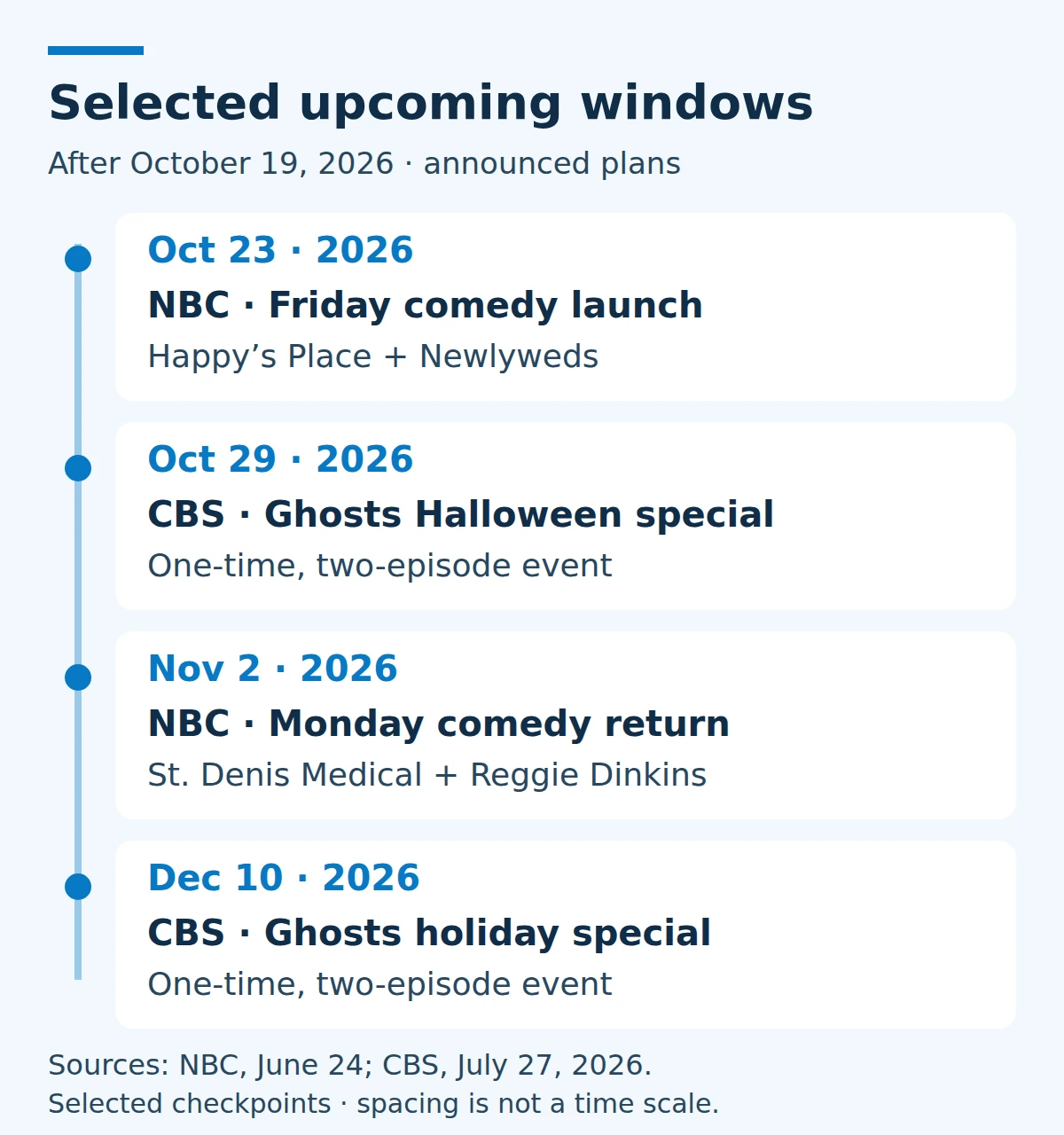
The selected NBC comedy launches below remain ahead of October 19 in its dated release. CBS also lists a later special that should be treated as an event rather than a new weekly slot.
| Published date in 2026 | Network and event | What to save |
|---|---|---|
| October 23 | NBC: Happy’s Place and new comedy Newlyweds | Friday launch; confirm the local listing before recording |
| October 29 | CBS: Ghosts Halloween two-episode special | One-time event, not a recurring Thursday reminder |
| November 2 | NBC: St. Denis Medical and The Fall and Rise of Reggie Dinkins | Monday comedy return |
| December 10 | CBS: Ghosts holiday two-episode special | Separate holiday event |
Sources: NBC, June 24, and CBS, July 27, 2026, linked above. These selected entries are planning checkpoints, not a claim that nothing else premieres during the period. A later network revision or the day’s local listing can supersede the original release.
Threshold rule: if the published premiere date is later than October 19, 2026, keep it in the upcoming queue; if it is on or before that date, check catch-up availability before treating it as a new live premiere. This rule sorts a dated plan. It does not prove that a scheduled broadcast took place.
How wide can a rollout window be?
A single network’s entertainment rollout can extend well beyond its opening night. Measure the interval between the relevant launches rather than counting the label “premiere week.”
Rollout span in calendar days = latest selected launch date − earliest selected launch date.
Worked example — NBC entertainment: November 2, 2026 − September 17, 2026 = 46 elapsed calendar days. Both endpoints are in NBC’s June 24 release. The calculation excludes its earlier football kickoff and measures the selected entertainment launch range, not the length of a show’s season.
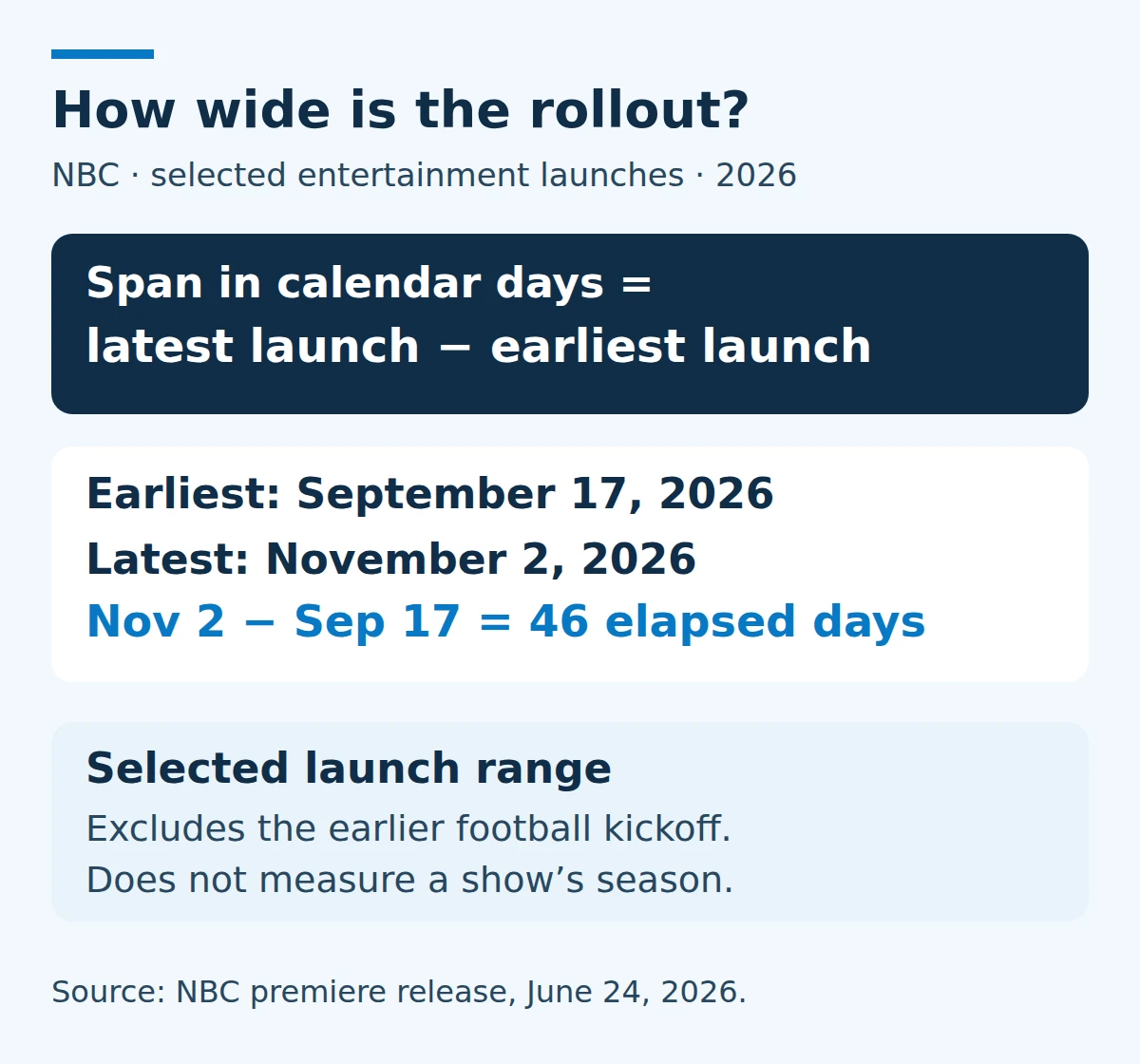
This is why a calendar entry for the network’s opening week is insufficient. Keep separate entries for the shows you intend to follow, and attach the release date so that a later announcement can be compared with the original plan.
When does a premiere window stop being a regular slot?
A premiere becomes a repeating viewing appointment only after checking the regular-slot note. An extended launch, a second episode on another night or a seasonal special may need a one-time reminder.
CBS’s release supplies a useful example: The Amazing Race starts September 30, with a one-off second episode on October 1 before the listed regular Wednesday period. The same release distinguishes the Ghosts specials from its second-half plan. FOX separately holds Baywatch, The Interrogator and Marriage Market for midseason. NBC assigns The Rockford Files to January and Sunset P.I. to February in its season plan.
Those are different kinds of information. A month-only hold is enough to retain a show on the watchlist, but it is insufficient for a dated reminder. A one-off episode date is enough for an event reminder, but it should not overwrite the recurring slot.
Before converting a printed time into a Denver viewing appointment, use how to read US TV premiere times and time zones. Preserve the release’s time-zone label and check the local feed; network clock notation and streaming availability are separate checks.
What is the time cost of following the schedule?
Budget the advertised broadcast slot when watching live, and check the actual episode runtime when catching up. An extended launch can take more of an evening than the regular slot; a network’s scheduled block includes advertising and is not a promise of uninterrupted episode footage.
The other cost is keeping reminders accurate. Save the network, show, premiere date, time-zone label, regular slot, one-off exceptions and source date together. Recheck the entries that are about to arrive instead of rebuilding the entire season grid. When comparing a show’s later audience coverage, the TV ratings and streaming views guide explains why different measurement windows cannot be read as interchangeable totals.
Method and sources
Updated October 19, 2026. This comparison uses NBCUniversal’s June 24, 2026 premiere release, CBS’s July 27, 2026 release and FOX’s fall 2026 premiere release, all checked on the update date. Dates are described as announced; this page does not verify individual transmissions, cancellations or streaming entitlements. The cutoff rule and elapsed-day calculation are editorial planning aids. The diagrams visualize the published rollout windows and the editorial calendar calculation. All schedule examples belong to fall 2026 or the stated midseason plan.