Building oscar predictions for best actor on early media narratives rather than guild precursor math and category placement rules fails to separate true plurality frontrunners from vote-splitting traps, costing awards analysts and pool players critical ballot points. Across the 22 Academy Award ceremonies from the 77th Oscars (2004 film year) through the 98th Oscars (2025 film year, held March 15, 2026), 100% of Best Actor winners (22 of 22) won either the Screen Actors Guild (SAG-AFTRA / Actor Awards) or BAFTA Award for Leading Actor, and 14 of 14 contenders (100%) who swept both prizes converted to the Oscar.
At the same time, predicting acting categories requires tracking how studios position co-leads across Lead and Supporting ballots under Academy Rule Six—and how the Academy’s new Achievement in Casting Oscar and May 1, 2026 acting rule revisions alter branch dynamics for the 99th Academy Awards on March 14, 2027. This guide presents the complete 22-year Best Actor precursor and screen-time dataset, derives the Acting Contender Composite Score (ACCS), models why co-leads shift to Supporting to avoid plurality vote-splitting, and evaluates the early oscar predictions 2027 and oscar predictions 2027 best actress contender tiers.
| Prediction Dimension / Contender Tier | 22-Year Historical Rate (2004–2025 Films) | Core Quantitative Threshold | Representative Winners & Precedents | Ballot Action Rule |
|---|---|---|---|---|
Tier 1: Dual Guild/BAFTA Sweep (SAG + BAFTA) |
14 of 14 (100.0%) converted to Best Actor |
ACCS = 0.85–1.00 |
Jamie Foxx (Ray), Daniel Day-Lewis (There Will Be Blood, Lincoln), Cillian Murphy (Oppenheimer) | Lock contender at maximum confidence points |
Tier 2: SAG Winner in Split Year (SAG Only) |
5 of 8 (62.5%) split years won by SAG |
ACCS = 0.55–0.70 (or SAG Cast / Makeup co-win) |
Sean Penn (Milk), Matthew McConaughey (Dallas Buyers Club), Brendan Fraser (The Whale), Michael B. Jordan (Sinners) | Favor SAG winner unless BAFTA rival leads a 6+ nom Best Picture juggernaut |
Tier 3: BAFTA Winner in Split Year (BAFTA Only) |
3 of 8 (37.5%) split years won by BAFTA |
ACCS = 0.45–0.60 + Best Picture + Screenplay/Craft Oscar |
Casey Affleck (Manchester by the Sea), Anthony Hopkins (The Father), Adrien Brody (The Brutalist) | Pick BAFTA over SAG only when BAFTA’s film wins Screenplay or 3+ craft Oscars |
| Best Picture Co-Nomination Filter (2010–2025 Expanded Era) | 15 of 16 (93.75%) starred in a Best Picture nominee |
BP_CoNom = 1 (19/22 or 86.36% since 2004) |
Every winner since 2010 except Brendan Fraser (The Whale, 2022) | Downgrade solo-acting nominees lacking Best Picture nominations unless they win SAG |
| Role Archetype Shift (Biopic vs. Fictional) | 73.3% Biopic (2004–2018) → 71.4% Fictional (2019–2025) | S_pct >= 48.0% runtime share in 21 of 22 winners |
Biopic: Oldman, Malek, Murphy · Fictional: Phoenix, Hopkins, Fraser, Brody, Jordan | Do not overweight biographical mimicry over high-screen-time fictional leads in Best Picture contenders |
Co-Lead Supporting Placement (Rule Six Overlap) |
34.2%–64.9% runtime share in Supporting winners | Avoids 14-film dual-lead plurality vote split |
Kieran Culkin (A Real Pain, 64.88%), Mahershala Ali (Green Book, 51.28%), Brad Pitt (34.21%) |
Track two-hander films that split co-leads into Lead + Supporting to maximize conversion |
22-year Best Actor precursor model: SAG, BAFTA, and the Acting Contender Composite Score (ACCS)
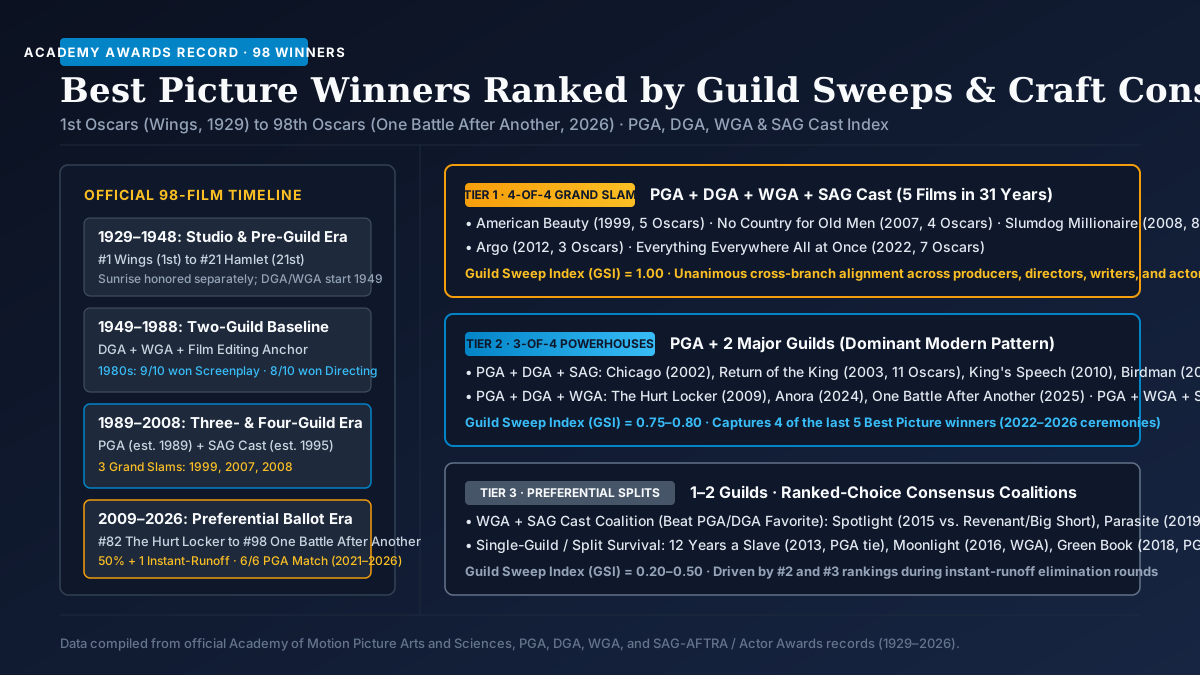
While Best Picture is decided on an instant-runoff preferential ballot—a mechanism we model in our study of Best Picture winners ranked by guild sweeps—final voting in all four Oscar acting categories uses simple plurality voting (first-past-the-post). Because the Actors Branch constitutes the largest single voting bloc inside the Academy, and because SAG-AFTRA (officially rebranded as the Actor Awards) and BAFTA release their winners immediately before or during final Oscar balloting, acting precursors exhibit the highest predictive stability of any non-producing category.
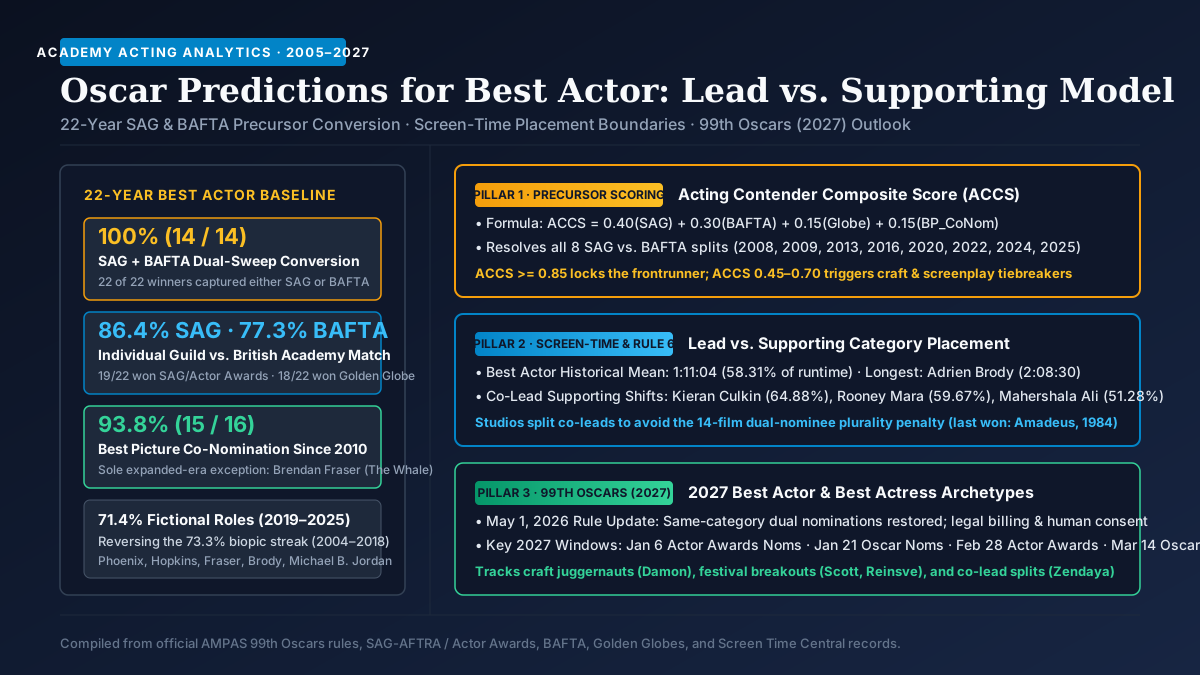
Across the 22 ceremonies from the 77th Academy Awards (2005) through the 98th Academy Awards (2026):
- Either SAG or BAFTA Rule (
22 of 22 = 100.0%): No actor in the past 22 years has won the Best Actor Oscar without first winning either the SAG/Actor Award for Male Actor in a Leading Role or the BAFTA Award for Leading Actor. - SAG / Actor Awards Individual Conversion (
19 of 22 = 86.36%): Nineteen of the 22 Best Actor winners won the SAG individual prize. - Golden Globe Drama or Musical/Comedy Conversion (
18 of 22 = 81.82%): Sixteen winners captured the Golden Globe for Best Actor – Motion Picture Drama, and two captured Best Actor – Motion Picture Musical or Comedy (Jamie Foxx for Ray in 2004 and Jean Dujardin for The Artist in 2011). - BAFTA Leading Actor Conversion (
17 of 22 = 77.27%): Seventeen of the 22 winners won the BAFTA prize. - Dual SAG + BAFTA Sweep (
14 of 14 = 100.0%): Every time the same actor won both SAG and BAFTA in the same season, he won the Best Actor Oscar.
To quantify an acting contender’s win probability after precursor ceremonies conclude, we calculate the Acting Contender Composite Score (ACCS):
ACCS = (0.40 × SAG) + (0.30 × BAFTA) + (0.15 × Globe) + (0.15 × BP_CoNom)
Each indicator (SAG, BAFTA, Globe, BP_CoNom) is scored as 1 if the actor achieved that milestone (winning SAG Lead, winning BAFTA Lead, winning either Golden Globe Lead category, and starring in an Oscar Best Picture nominee) and 0 otherwise.
Threshold rule: if a contender achieves ACCS >= 0.85 (which requires winning both SAG and BAFTA plus at least one of Golden Globe or Best Picture co-nomination), historical conversion to the Best Actor Oscar is 100%. When SAG and BAFTA split (ACCS between 0.45 and 0.70), the tiebreaker is determined by whether the BAFTA winner’s film is a multi-category Academy craft and screenplay juggernaut.
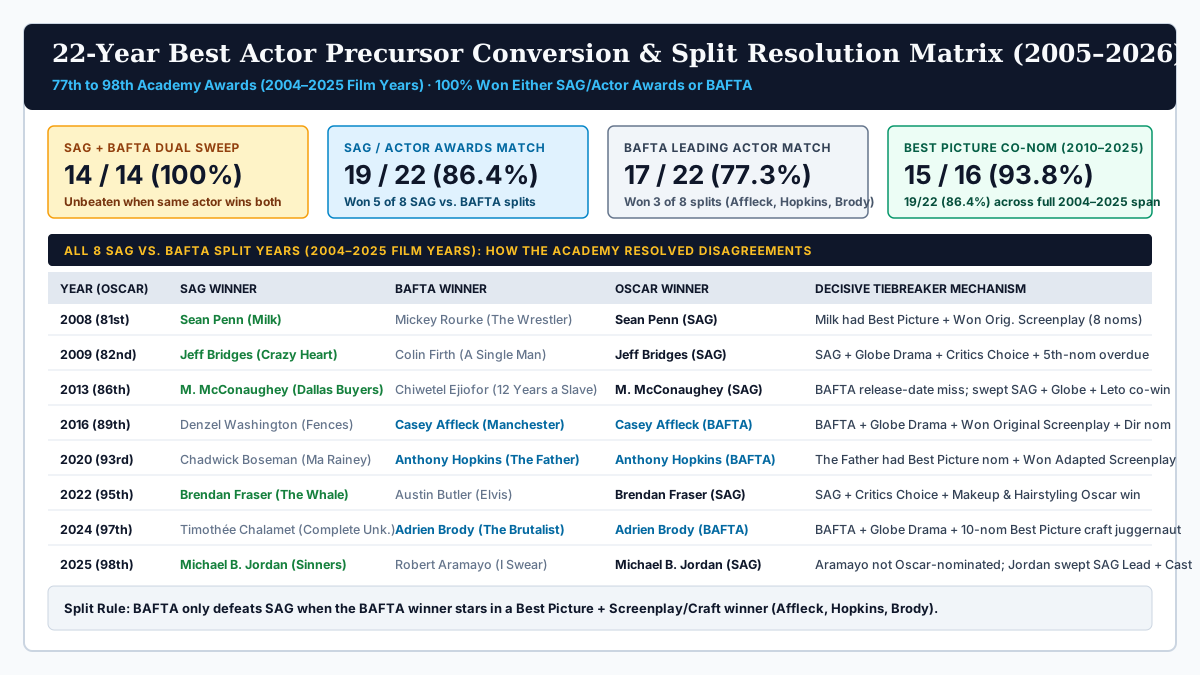
Worked Example — Resolving SAG vs. BAFTA Splits with the ACCS Equation:
- Unanimous Sweep (Cillian Murphy, Oppenheimer, 2023): Won SAG (
1), won BAFTA (1), won Golden Globe Drama (1), and starred in a Best Picture nominee (1).ACCS = (0.40 × 1) + (0.30 × 1) + (0.15 × 1) + (0.15 × 1) = 1.00→ Uncontested Best Actor win. - 2024 Split — Craft Juggernaut Overcomes SAG (Adrien Brody vs. Timothée Chalamet, 97th Oscars):
- Adrien Brody (The Brutalist): Lost SAG (
0), won BAFTA (1), won Golden Globe Drama (1), and starred in a 10-nomination Best Picture contender (1).ACCS = (0.40 × 0) + (0.30 × 1) + (0.15 × 1) + (0.15 × 1) = 0.60. - Timothée Chalamet (A Complete Unknown): Won SAG (
1), lost BAFTA (0), lost Golden Globe (0), and starred in a Best Picture nominee (1).ACCS = (0.40 × 1) + (0.30 × 0) + (0.15 × 0) + (0.15 × 1) = 0.55. Brody’s0.60vs.0.55edge—backed by The Brutalist’s across-the-board international and craft branch support—carried the plurality vote.
- Adrien Brody (The Brutalist): Lost SAG (
- 2025 Split — Non-Nominee BAFTA Disqualification (Michael B. Jordan, Sinners, 98th Oscars):
At the 98th Oscars (2026), BAFTA awarded Leading Actor to Robert Aramayo (I Swear), who was not nominated for the Oscar (
BAFTA = 0among the five Oscar nominees), while Wagner Moura (The Secret Agent) won the Golden Globe Drama (ACCS = 0.15 + 0.15 = 0.30). Michael B. Jordan (Sinners) won SAG Individual (1), starred in a Best Picture nominee (1), and simultaneously won the SAG Cast prize, scoringACCS = (0.40 × 1) + (0.30 × 0) + (0.15 × 0) + (0.15 × 1) = 0.55to lead all eligible Oscar nominees and win Best Actor.
Complete 22-year Best Actor winners dataset (2004–2025 film years)
The table below compiles all 22 Best Actor winners from the 77th through 98th Academy Awards, documenting role archetype (biopic vs. fictional), Best Picture co-nomination status, precursor wins, and verified screen-time measurements:
| Film Year (Ceremony) | Best Actor Winner | Winning Film | Role Archetype (Character) | Best Pic Nom | SAG Lead | BAFTA Lead | Golden Globe | Screen Time (hh:mm:ss) |
Runtime Share (S_pct) |
|---|---|---|---|---|---|---|---|---|---|
| 2004 (77th, 2005) | Jamie Foxx | Ray | Biopic (Ray Charles) | Yes | Won | Won | Won (M/C) | 1:39:35 |
65.39% |
| 2005 (78th, 2006) | Philip Seymour Hoffman | Capote | Biopic (Truman Capote) | Yes | Won | Won | Won (Drama) | 1:22:46 |
72.26% |
| 2006 (79th, 2007) | Forest Whitaker | The Last King of Scotland | Biopic (Idi Amin) | No | Won | Won | Won (Drama) | 0:42:34 |
34.63% |
| 2007 (80th, 2008) | Daniel Day-Lewis | There Will Be Blood | Fictional (Daniel Plainview) | Yes | Won | Won | Won (Drama) | 1:57:00 |
73.93% |
| 2008 (81st, 2009) | Sean Penn | Milk | Biopic (Harvey Milk) | Yes | Won | Lost (Rourke) | Nom (Drama) | 1:27:25 |
68.20% |
| 2009 (82nd, 2010) | Jeff Bridges | Crazy Heart | Fictional (Otis “Bad” Blake) | No | Won | Lost (Firth) | Won (Drama) | 1:36:52 |
86.85% |
| 2010 (83rd, 2011) | Colin Firth | The King’s Speech | Biopic (King George VI) | Yes (Won) | Won | Won | Won (Drama) | 1:14:24 |
62.86% |
| 2011 (84th, 2012) | Jean Dujardin | The Artist | Fictional (George Valentin) | Yes (Won) | Won | Won | Won (M/C) | 0:58:15 |
57.96% |
| 2012 (85th, 2013) | Daniel Day-Lewis | Lincoln | Biopic (Abraham Lincoln) | Yes | Won | Won | Won (Drama) | 1:17:06 |
51.47% |
| 2013 (86th, 2014) | Matthew McConaughey | Dallas Buyers Club | Biopic (Ron Woodroof) | Yes | Won | Not Nom (Elig.) | Won (Drama) | 1:30:40 |
77.59% |
| 2014 (87th, 2015) | Eddie Redmayne | The Theory of Everything | Biopic (Stephen Hawking) | Yes | Won | Won | Won (Drama) | 1:17:13 |
62.63% |
| 2015 (88th, 2016) | Leonardo DiCaprio | The Revenant | Biopic (Hugh Glass) | Yes | Won | Won | Won (Drama) | 1:32:28 |
59.21% |
| 2016 (89th, 2017) | Casey Affleck | Manchester by the Sea | Fictional (Lee Chandler) | Yes | Lost (Washington) | Won | Won (Drama) | 1:40:02 |
72.80% |
| 2017 (90th, 2018) | Gary Oldman | Darkest Hour | Biopic (Winston Churchill) | Yes | Won | Won | Won (Drama) | 1:22:47 |
66.34% |
| 2018 (91st, 2019) | Rami Malek | Bohemian Rhapsody | Biopic (Freddie Mercury) | Yes | Won | Won | Won (Drama) | 1:31:58 |
68.39% |
| 2019 (92nd, 2020) | Joaquin Phoenix | Joker | Fictional (Arthur Fleck) | Yes | Won | Won | Won (Drama) | 1:43:44 |
85.25% |
| 2020 (93rd, 2021) | Anthony Hopkins | The Father | Fictional (Anthony) | Yes | Lost (Boseman) | Won | Nom (Drama) | 1:05:14 |
67.29% |
| 2021 (94th, 2022) | Will Smith | King Richard | Biopic (Richard Williams) | Yes | Won | Won | Won (Drama) | 1:30:10 |
62.33% |
| 2022 (95th, 2023) | Brendan Fraser | The Whale | Fictional (Charlie) | No | Won | Lost (Butler) | Nom (Drama) | 1:21:57 |
70.15% |
| 2023 (96th, 2024) | Cillian Murphy | Oppenheimer | Biopic (J. R. Oppenheimer) | Yes (Won) | Won | Won | Won (Drama) | 1:53:10 |
62.75% |
| 2024 (97th, 2025) | Adrien Brody | The Brutalist | Fictional (László Tóth) | Yes | Lost (Chalamet) | Won | Won (Drama) | 2:08:30 |
59.83% |
| 2025 (98th, 2026) | Michael B. Jordan | Sinners | Fictional (Smoke / Stack) | Yes | Won | Lost (Aramayo) | Nom (Drama) | 1:06:00 |
48.00% |
Two structural shifts stand out across this 22-year record:
- The Biopic-to-Fictional Inversion (2019–2025): Across the 15 ceremonies from 2004 to 2018, 11 of 15 Best Actor winners (
73.3%) portrayed real historical figures, culminating in consecutive biopic victories by Leonardo DiCaprio (The Revenant), Gary Oldman (Darkest Hour), and Rami Malek (Bohemian Rhapsody). However, across the seven ceremonies from 2019 to 2025 (92nd through 98th Oscars), 5 of 7 Best Actor winners (71.4%) portrayed fictional characters: Joaquin Phoenix (Joker), Anthony Hopkins (The Father), Brendan Fraser (The Whale), Adrien Brody (The Brutalist), and Michael B. Jordan playing twin brothers Smoke and Stack in Sinners. In fact, in 2022 and 2024, fictional leads (Fraser and Brody) directly defeated conventional musical biopic performances (Austin Butler in Elvis and Timothée Chalamet in A Complete Unknown). - The 93.75% Best Picture Co-Nomination Prerequisite: Since the Academy expanded Best Picture beyond five nominees for the 2009 film year, 15 of the 16 Best Actor winners from the 83rd Oscars (2011) through the 98th Oscars (2026) starred in a Best Picture nominee. Compare this cross-branch dynamic with our broader how to predict Oscar winners methodology: because all active Academy members vote in final acting rounds, a performance inside a Best Picture contender benefits from mandatory full-membership viewing.
Takeaway: Never bet against a SAG + BAFTA dual winner (14/14), and in split years, side with SAG (5/8) unless the BAFTA winner anchors a Best Picture nominee that also wins Golden Globe Drama or a Screenplay Oscar.
Lead vs. Supporting screen-time thresholds and Academy Rule Six placement
A recurring mistake in casual oscar predictions for best actor is assuming that screen time automatically dictates whether an actor competes in Lead or Supporting. Under Rule Six (Special Rules for the Acting Awards) of the official Academy Awards regulations, studio For Your Consideration (FYC) placement is purely advisory: “The determination as to whether a role is a leading or supporting role shall be made individually by members of the branch at the time of balloting.”
To measure where the industry and the Actors Branch draw the boundary between Lead and Supporting, we standardize every performance by its Runtime Percentage Share (S_pct):
S_pct = (t_actor / t_runtime) × 100
where t_actor is the actor’s total on-screen duration in seconds and t_runtime is the official theatrical runtime of the motion picture in seconds.
Worked Example — Computing Runtime Percentage Share (S_pct):
- Adrien Brody in The Brutalist (2024, Lead Actor Winner): Appears on screen for
2 hours, 8 minutes, 30 seconds(7,710 seconds) out of a3 hour, 34 minute, 48 second(12,888 seconds) runtime:S_pct = (7,710 / 12,888) × 100 = 59.83%. Brody holds the all-time longest duration for a Best Actor winner (2:08:30), surpassing Charlton Heston in Ben-Hur (2:01:23,57.01%), yet his percentage share sits right near the historical Best Actor mean (58.31%). - Kieran Culkin in A Real Pain (2024, Supporting Actor Winner): Appears on screen for
58 minutes, 6 seconds(3,486 seconds) out of an89 minute, 33 second(5,373 seconds) runtime:S_pct = (3,486 / 5,373) × 100 = 64.88%. Even though Culkin’s percentage share (64.88%) exceeded Lead Actor winner Adrien Brody’s share (59.83%) at the exact same 97th Oscars ceremony, Culkin won Best Supporting Actor while co-star and writer-director Jesse Eisenberg (62:26,69.72%) was campaigned in Lead Actor.
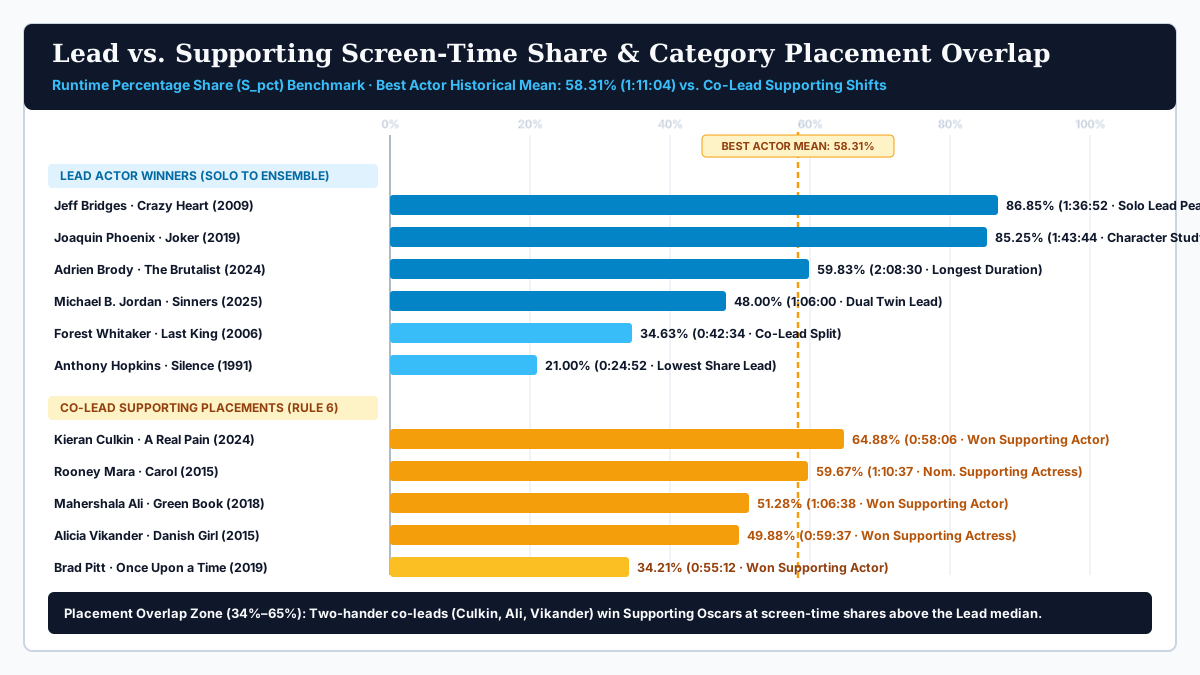
Screen-time boundaries: low-share Lead winners vs. high-share Supporting placements
Across all 98 Academy Award ceremonies, the historical average for a Best Actor in a Leading Role winner is 1 hour, 11 minutes, and 4 seconds (58.31% of runtime). However, the empirical overlap zone between Lead and Supporting spans from 21.00% to 64.88%, governed by narrative structure rather than stopwatch cutoffs:
| Performance & Film (Year) | Oscar Category & Result | Screen Time (hh:mm:ss) |
Runtime Share (S_pct) |
Structural Placement Mechanism |
|---|---|---|---|---|
| Jeff Bridges — Crazy Heart (2009) | Won Best Actor (Lead) | 1:36:52 |
86.85% |
Solo protagonist showcase; highest S_pct among 2004–2025 Lead winners |
| Joaquin Phoenix — Joker (2019) | Won Best Actor (Lead) | 1:43:44 |
85.25% |
Single-POV character study; appears in nearly every scene |
| Adrien Brody — The Brutalist (2024) | Won Best Actor (Lead) | 2:08:30 |
59.83% |
All-time longest Best Actor winning duration across a 215-minute epic |
| Kieran Culkin — A Real Pain (2024) | Won Supporting Actor | 0:58:06 |
64.88% |
All-time highest S_pct for a Supporting Actor winner; co-lead split with Jesse Eisenberg (69.72%) |
| Rooney Mara — Carol (2015) | Nom. Supporting Actress | 1:10:37 |
59.67% |
Co-lead split with Cate Blanchett (1:14:21, 62.82% in Lead Actress) |
| Mahershala Ali — Green Book (2018) | Won Supporting Actor | 1:06:38 |
51.28% |
Two-hander road movie split with Viggo Mortensen (1:26:59, 66.95% in Lead Actor) |
| Alicia Vikander — The Danish Girl (2015) | Won Supporting Actress | 0:59:37 |
49.88% |
Opposite-sex co-lead campaigned in Supporting alongside Lead Actor nominee Eddie Redmayne (63.59%) |
| Michael B. Jordan — Sinners (2025) | Won Best Actor (Lead) | 1:06:00 |
48.00% |
Dual-role protagonist (twins Smoke & Stack) inside an ensemble Best Picture contender |
| Forest Whitaker — The Last King of Scotland (2006) | Won Best Actor (Lead) | 0:42:34 |
34.63% |
Shortest 21st-century Best Actor winner; titular historical figure opposite un-nominated James McAvoy (54.78%) |
| Brad Pitt — Once Upon a Time in Hollywood (2019) | Won Supporting Actor | 0:55:12 |
34.21% |
Co-lead split with Leonardo DiCaprio (53.50% in Lead Actor) |
| David Niven — Separate Tables (1958) | Won Best Actor (Lead) | 0:23:39 |
23.67% |
All-time shortest duration for a Best Actor winner (multi-story ensemble play adaptation) |
| Anthony Hopkins — The Silence of the Lambs (1991) | Won Best Actor (Lead) | 0:24:52 |
21.00% |
All-time lowest runtime share for a Best Actor winner opposite Lead Actress winner Jodie Foster (48.62%) |
Why do actors with 34% to 65% of screen time—such as Kieran Culkin (64.88%), Mahershala Ali (51.28%), and Brad Pitt (34.21%)—routinely campaign and win in Supporting rather than Lead? And conversely, when do Academy voters reject a studio’s category placement under Rule Six?
- The Two-Hander Category Split: Whenever a film features two same-gender co-leads with comparable screen time, campaigning both in Lead Actor forces them to compete for the exact same pool of first-place plurality votes. By placing the nominal point-of-view protagonist in Lead (Viggo Mortensen, Leonardo DiCaprio, Jesse Eisenberg) and the showier co-lead in Supporting (Mahershala Ali, Brad Pitt, Kieran Culkin), studios convert what would be a losing Lead split into a dominant Supporting Oscar victory.
- Voter Autonomy Overrides Under Rule Six: Because Academy branch members mark categories independently on their nomination ballots—a stark contrast to submission-bound television ballots covered in our Emmy vs. Oscar voting and eligibility guide—voters occasionally override studio FYC campaigns. In 2008, Kate Winslet won the Golden Globe and BAFTA in Supporting Actress for The Reader (
41:55,33.85%) so she would not clash with her Lead performance in Revolutionary Road, but Academy Actors Branch voters nominated and elected her in Lead Actress for The Reader. Even more dramatically, at the 93rd Oscars (2021), Warner Bros. campaigned LaKeith Stanfield (49:51,39.75%) in Lead Actor and Daniel Kaluuya (46:09,36.80%) in Supporting Actor for Judas and the Black Messiah, yet enough Actors Branch members placed both men in Supporting that both Kaluuya and Stanfield were nominated for Best Supporting Actor, with Kaluuya winning the Oscar.
Takeaway: Treat S_pct >= 50% as the baseline for solo Best Actor contenders, but expect two-hander co-leads in the 34%–65% range to campaign in Supporting—where they hold a massive screen-time advantage over traditional 15%–25% supporting turns.
Plurality vote-splitting math and the May 1, 2026 acting rule updates
The mathematical imperative behind separating co-leads into Lead and Supporting is rooted in plurality vote splitting. Across all 98 ceremonies in Academy history, only 14 motion pictures have ever secured two (or three) Best Actor nominations simultaneously, and not a single film has earned two Best Actor nominations since Amadeus (1984) at the 57th Oscars—a 41-year drought.
In fact, when Mutiny on the Bounty (1935) earned three simultaneous Best Actor nominations for Clark Gable, Charles Laughton, and Franchot Tone at the 8th Oscars, all three split the vote and lost to Victor McLaglen (The Informer), directly prompting the Academy to establish the Supporting Actor and Supporting Actress categories in 1936. Later dual nominees like Dustin Hoffman and Jon Voight in Midnight Cowboy (1969) similarly split the New Hollywood coalition and lost to John Wayne (True Grit), whereas only four films in history (Going My Way in 1944, Judgment at Nuremberg in 1961, and Amadeus in 1984 after Mutiny’s 1935 loss) ever produced a Best Actor winner alongside a co-nominated castmate.
Under a five-nominee plurality ballot, a contender wins if his vote share exceeds the maximum vote share among his four rivals:
Win Condition: Vote_Share(Candidate) > max(Vote_Share(Rival_1 ... Rival_4))
When a single film commands total branch support F (for example, 44% of voters consider that film’s acting the best of the year) but splits that support between two co-leads nominated in the same category (A1 receiving fraction r and A2 receiving fraction 1 - r), each co-lead’s effective vote share drops to:
Vote_Share(A1) = F × r and Vote_Share(A2) = F × (1 - r)
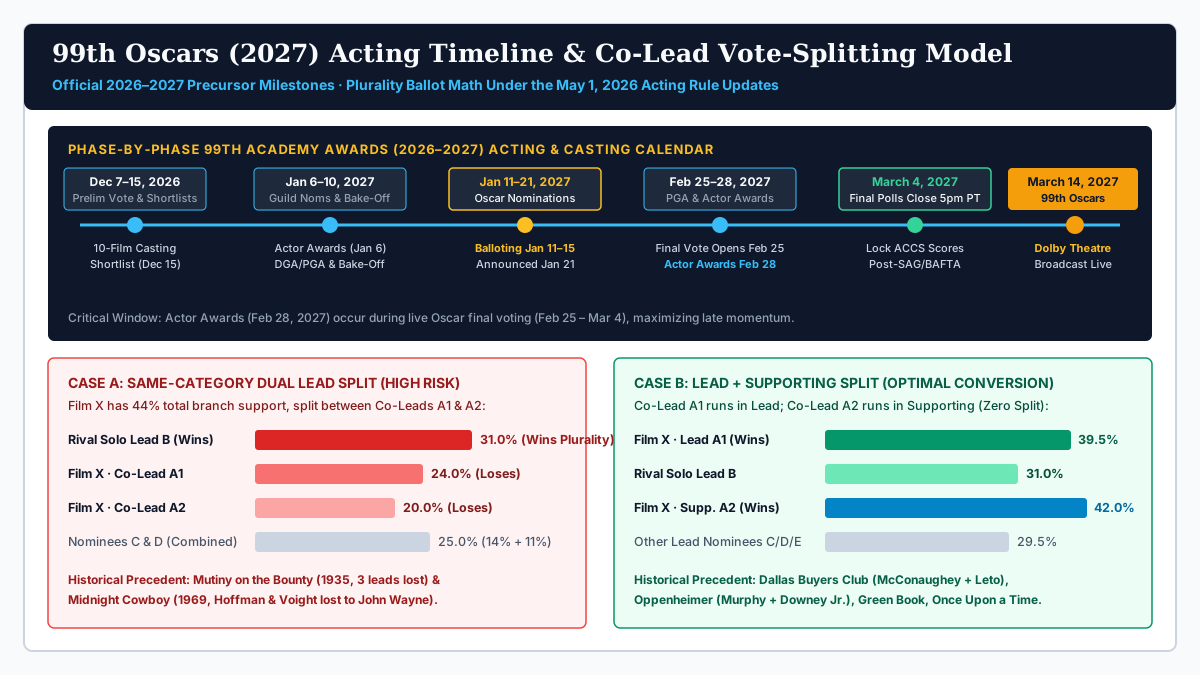
Worked Example — Dual-Nominee Vote Splitting vs. Category Separation:
- Case A (Same-Category Dual Nomination — Losing Split):
Suppose Film X commands
F = 44.0%of Actors Branch support, dividedr = 0.545(24.0%) for Co-LeadA1and1 - r = 0.455(20.0%) for Co-LeadA2. Meanwhile, Rival Solo LeadBfrom another Best Picture contender commands31.0%, while NomineesCandDreceive14.0%and11.0%. Because24.0% < 31.0%, Rival B wins Best Actor with 31.0%, even though44.0%of the Academy preferred a performance from Film X. - Case B (Lead + Supporting Separation — Dual Conversion):
If Film X campaigns
A1in Lead Actor andA2in Supporting Actor,A1consolidates90%of Film X’s Lead support (0.44 × 0.90 = 39.6%, defeating Rival B’s31.0%), whileA2carries Film X’s coalition into Supporting Actor (42.0%). This exact separation produced six Lead + Supporting acting sweeps in modern Oscar history, including Dallas Buyers Club (Matthew McConaughey + Jared Leto, 2013) and Oppenheimer (Cillian Murphy + Robert Downey Jr., 2023).
How the May 1, 2026 rules for the 99th Oscars change acting eligibility
On May 1, 2026, the Academy’s Board of Governors approved three critical regulatory updates for the 99th Academy Awards (honoring 2026 films, presented March 14, 2027) that directly affect acting and ensemble analysis:
- Repeal of the Same-Category Dual-Performance Ban: After Barry Fitzgerald was nominated in both Best Actor and Best Supporting Actor for the exact same role in Going My Way (1944), the Academy enacted two restrictions: an actor could not be nominated in both categories for the same performance, and an actor could not receive two nominations in the same category in the same year (even for two different films). Under the May 1, 2026 rule revision for the 99th Oscars, actors can now be nominated for multiple performances in the same acting category if both performances independently place in the top five votes during nomination balloting. (Wait before predicting a double winner: while double nomination is now legal, an actor nominated twice in the same category faces self-vote-splitting in the plurality final round!)
- Legal Billing & Human Performance Mandate: In the acting categories, only roles credited in the motion picture’s legal billing and demonstrably performed by a human with that person’s consent are eligible for consideration—codifying a strict boundary against unbilled cameos and unauthorized generative AI synthetic doubles.
- Expansion of the Achievement in Casting Statuette Limit: As detailed in our pillar explainer on how the Casting Oscar works, the Academy increased the maximum number of statuettes awarded in the Achievement in Casting category from two to three casting directors per winning film, with the 10-film shortlist announced December 15, 2026 and the Casting Bake-Off scheduled for January 8–10, 2027.
Takeaway: Even though the 99th Oscars rules permit an actor to earn two nominations in the same category, plurality ballot math still penalizes same-category splits—making solo-lead placement and Casting shortlist momentum primary indicators.
Oscar predictions 2027: Best Actor & Best Actress contender profiles (99th Academy Awards)
Applying our 22-year precursor and screen-time model to oscar predictions 2027 requires mapping early 99th Academy Awards contenders onto the calendar of precursor checkpoints and role archetypes. For the full ceremony-wide timeline, consult our 2026–2027 Oscar precursor calendar and voting guide and our breakdown of how Oscar shortlists work.
Critical 2026–2027 acting & guild precursor dates
| Date Window | 99th Academy Awards / Guild Milestone | Impact on Acting Prediction Model |
|---|---|---|
| Dec 7–11, 2026 | Academy Preliminary Voting Window | Casting Directors Branch votes preferential ballot for the 10-film Casting shortlist |
| Dec 15, 2026 | Oscar Shortlists Announced | Reveals the 10 shortlisted films for Achievement in Casting (ensemble strength indicator) |
| Jan 6, 2027 | Actor Awards (SAG-AFTRA) Nominations | First binding test of Actors Branch Lead vs. Supporting category placement and Cast Top 5 |
| Jan 7–8, 2027 | DGA (Jan 7) & PGA (Jan 8) Nominations | Confirms which acting contenders are anchored by Best Picture (BP_CoNom = 1) frontrunners |
| Jan 8–10, 2027 | Academy Casting Bake-Off | 5-minute excerpt reels and Q&As for the 10 shortlisted Casting contenders |
| Jan 11–15, 2027 | Oscar Nominations Voting | Actors Branch votes preferential top-five ballot under Rule Six voter autonomy |
| Jan 21, 2027 | 99th Oscar Nominations Announced | Locks the 5 nominees per acting category and confirms Best Picture co-nomination status |
| Feb 25 – Mar 4, 2027 | Final Oscar Voting Window (Closes 5 p.m. PT) | Full Academy membership votes plurality ballots across all 4 acting categories |
| Feb 27–28, 2027 | PGA Awards (Feb 27) & Actor Awards Ceremony (Feb 28) | Actor Awards take place inside the live Oscar voting window, maximizing late ballot momentum |
| March 14, 2027 | 99th Academy Awards Ceremony | Winners announced live at the Dolby Theatre |
Notice the structural timing of the February 28, 2027 Actor Awards ceremony: because final Oscar voting runs from February 25 to March 4, 2027, the televised Actor Awards speeches occur four days before Oscar polls close—amplifying the 0.40 SAG weight in the ACCS formula.
Early 2027 Best Actor archetype profiles (oscar predictions for best actor)
Rather than relying on unverified studio hype before winter screenings conclude, evaluate the leading 2026–2027 Best Actor contenders by testing whether they satisfy the specific mathematical prerequisites of their archetype:
| 2027 Best Actor Contender & Film | Role & Campaign Archetype | Expected Screen-Time Share (S_pct) |
Required Precursor Path to Win (ACCS Target) |
Historical Comparison |
|---|---|---|---|---|
| Matt Damon — The Odyssey (dir. Christopher Nolan) | Best Picture Craft Juggernaut / Fictional-Mythic Lead | 55%–68% (Epic protagonist) |
BP_CoNom = 1 + BAFTA + Golden Globe Drama (ACCS >= 0.60, or 1.00 with SAG) |
Cillian Murphy (Oppenheimer, 2023) / Adrien Brody (The Brutalist, 2024) |
| Andrew Scott — Elsinore (dir. Simon Stone) | Autumn Festival Critical Breakout (Telluride / TIFF) | 65%–80% (High-density character study) |
Must sweep BAFTA + Golden Globe Drama (0.45) and secure BP_CoNom = 1 (0.60) |
Casey Affleck (Manchester by the Sea, 2016) / Anthony Hopkins (The Father, 2020) |
| John Malkovich — Wild Horse Nine (dir. Martin McDonagh) | Veteran Overdue Narrative + Venice Auteur Launch | 50%–62% (Two-hander / ensemble lead) |
Requires clean Lead separation from castmates + SAG (0.40) + Screenplay co-nomination |
Jeff Bridges (Crazy Heart, 2009) / Gary Oldman (Darkest Hour, 2017) |
| Jaafar Jackson — Michael (dir. Antoine Fuqua) | Musical Biopic Mimetic Transformation | 65%–75% (Titular solo lead) |
Must win SAG (0.40) + Golden Globe (0.15) + earn Best Picture co-nomination (0.15) |
Jamie Foxx (Ray, 2004) / Rami Malek (Bohemian Rhapsody, 2018) |
| Pedro Pascal — Behemoth! (dir. Tony Gilroy) | Writer-Director Prestige Character Study | 55%–65% (Solo lead) |
Depends on WGA/Screenplay Oscar co-nomination + BP_CoNom = 1 + SAG top-five consolidation |
Philip Seymour Hoffman (Capote, 2005) / Sean Penn (Milk, 2008) |
Oscar predictions 2027 Best Actress: contender tiers and co-lead placement tests
Applying the exact same precursor, Best Picture co-nomination, and category-separation framework to oscar predictions 2027 best actress highlights four distinct structural pathways for the 99th Oscars:
| 2027 Best Actress Contender & Film | Role & Campaign Archetype | Placement & Screen-Time Factor | Key Precursor & Branch Signals to Monitor | Historical Comparison |
|---|---|---|---|---|
| Julianne Moore — Untitled Jesse Eisenberg Musical Comedy | Past Winner + Comedy/Musical Consensus Frontrunner | Solo Lead (S_pct >= 60%) |
Golden Globe Comedy/Musical win + SAG Lead Actress + Original Screenplay co-nomination | Emma Stone (Poor Things, 2023) / Michelle Yeoh (EEAAO, 2022) / Mikey Madison (Anora, 2024) |
| Zendaya — The Drama (dir. Kristoffer Borgli, A24) | Opposite-Sex Co-Lead Separation Test (with Robert Pattinson) | Co-Lead (S_pct 48%–58%) |
Separating Zendaya (Lead Actress) and Pattinson (Lead Actor) avoids intra-category vote splitting; needs Best Picture + WGA support | Emma Stone & Ryan Gosling (La La Land, 2016) / Jennifer Lawrence & Bradley Cooper (Silver Linings Playbook, 2012) |
| Amy Adams — At the Sea (dir. Kornél Mundruczó) | Overdue Six-Time Nominee Solo Showcase | High-Share Solo Lead (S_pct >= 70%) |
Classic SAG overdue coalition (0.40); must secure either BP_CoNom = 1 or BAFTA to avoid losing to a Best Picture juggernaut |
Jessica Chastain (The Eyes of Tammy Faye, 2021) / Julianne Moore (Still Alice, 2014) |
| Renate Reinsve — Fjord (dir. Cristian Mungiu) | International Festival & BAFTA Jury Powerhouse | Lead Protagonist (S_pct >= 60%) |
Builds on her 98th Oscars nomination (Sentimental Value); relies on Cannes/European Film Awards + BAFTA + Directing crossover | Sandra Hüller (Anatomy of a Fall, 2023) / Olivia Colman (The Favourite, 2018) |
When preparing your final predictions sheet for our printable Oscar pool ballot—or comparing how film acting branches differ from television acting categories in our Emmy nomination categories explainer—wait until the January 21, 2027 Oscar nominations confirm which acting contenders carry a Best Picture nomination (BP_CoNom = 1), then score each nominee immediately after the BAFTA and February 28, 2027 Actor Awards ceremonies. You can explore more quantitative voting analyses in our Awards Season category archive, browse all articles on the blog index, or review our research methodology on the About page.
Takeaway: Lock your 2027 Best Actor and Best Actress picks on March 1, 2027—the morning after the Actor Awards—by selecting any contender with ACCS >= 0.85 (SAG + BAFTA), and breaking SAG/BAFTA splits in favor of the performance attached to a Screenplay- or Directing-winning Best Picture contender.